Los Tres Ojos: Santo Domingo's Cave Lakes Guide
August 2026 · 22 min read
Los Tres Ojos is the easiest half-day trip you can take from the Colonial Zone, and one of the stranger sights in the whole city. Twenty minutes east of the old town, across the Ozama river, the flat ground of eastern Santo Domingo simply drops away, and you walk down a stone staircase into a sunken world of cool turquoise water, hanging roots, and pale limestone. The name means "the three eyes," after three open sinkhole lakes you reach on foot. There is a fourth lake too, hidden behind the rock, and you cross to it on a small raft that a man pulls along a cable by hand.
It is quick, it is cheap, and it is genuinely beautiful in a way photographs undersell. It is also busier than it should be by mid-morning, involves a real flight of uneven steps, and takes less time than most people budget for it. This guide covers what the lakes actually are, how long to give the visit, when to go to dodge the tour buses, roughly what it costs, how to get there without renting a car, and how to pair it with the Faro a Colón next door so the trip across the river earns itself.
What Los Tres Ojos actually is
Los Tres Ojos sits inside a limestone park at the eastern edge of the city, in the green expanse of the Parque Mirador del Este. From the road and the ticket gate you would never guess it is there. You buy a ticket, walk a short path, and then the ground opens: a collapsed cavern, roughly the length of a city block, with its roof partly fallen in so that daylight pours down onto still, clear pools far below.
The whole thing is a karst formation, which is the geologist's word for what happens when slightly acidic rainwater spends a few hundred thousand years dissolving soft limestone. Underground rivers hollowed out the rock, the ceilings thinned, and eventually sections of the roof collapsed and left these open-topped chambers. What you are looking at, in plain terms, is the inside of an old cave system with the lid taken off. The water in the pools is fresh, fed from below, and it stays cool and clear year round because it never sits long in the sun.
That is the short version of why the place feels the way it does. You descend out of the flat, hot, ordinary streets of the eastern city and within thirty seconds the temperature drops, the light goes green, and the noise of traffic disappears behind stone. It is one of the few sights near the Colonial Zone that surprises even people who have already seen a lot of the Caribbean.
A word on the name before we go further. "Los Tres Ojos" translates as "the three eyes," and the three eyes are the three lakes you can see and reach without a boat. Most visitors are surprised to learn there is a fourth, which is the point of the raft. So the honest description is three open cave lakes plus a hidden fourth lagoon, and a lot of the pleasure of the visit is walking from one to the next and watching the light and the water change.
The caves before the tourists
The lakes did not become an attraction yesterday. Long before there was a ticket gate, the indigenous Taíno who lived across Hispaniola are widely believed to have used the island's caves and freshwater sinkholes, for shelter, for water, and in places for ritual. Cave sites elsewhere on the island still carry Taíno rock art, and it is easy to stand at the edge of these cool, hidden pools and understand why a people would have treated a place like this as more than a water source. Treat the specifics with a light hand, since firm records from that era are thin, but the broad picture is real: this was a known, used landscape for a very long time before Spanish ships ever appeared off the coast.
The site opened to the public as a protected park in the twentieth century, and it has been a fixture on the Santo Domingo sightseeing circuit for decades since. That long history as an organized attraction is why the infrastructure is here: the carved steps, the railings, the one-way path, and the raft with its fixed cable are all the result of the site being managed for visitors for a long time. It is worth holding both pictures in your head at once, the ancient natural formation and the well-worn tourist stop, because Los Tres Ojos is genuinely both. The rock is hundreds of thousands of years old; the ticket booth and the coach parking are the modern layer bolted onto it. Knowing that keeps your expectations honest: you are visiting a remarkable piece of geology through the front door of a busy city attraction, not discovering a secret.
The three eyes, and the hidden fourth
You follow a one-way route down and around, and the lakes appear in sequence. Names vary a little depending on which guide or sign you read, so treat the labels below as the common versions rather than gospel, and do not be surprised if a local guide uses slightly different ones.
The first eye
The first lake you reach is usually called the Lago de Azufre, the sulfur lake. It is the one most people photograph first, a broad sheet of green-blue water sitting under a high broken ceiling, with roots and vines trailing down the rock walls toward the surface. The greenish tint and the faint mineral smell are where the sulfur name comes from. It is the biggest open view of the trip and the one that makes people stop talking for a second, so give yourself a minute here before you move on.
The second eye
Deeper in, the route reaches a colder, darker pool often called La Nevera, "the refrigerator" or "the icebox." The name is not marketing. This chamber holds the least sun and the clearest, coldest water of the set, a deep still blue-black that looks bottomless. It is the most cave-like of the four, the walls close in, the light is thin, and the quiet is total. People tend to speak in lower voices here without being told to.
The third eye
The third lake opens up again toward the sky, letting in more daylight and more greenery. This is the one that feels most like a jungle grotto, with plants spilling over the rim high above and the water taking on a brighter turquoise where the sun hits it. Between these three you will have walked maybe a couple hundred meters of paved and carved path, with railings on the exposed drops, and you will already feel you have seen the place. Then you find the raft.
The fourth, hidden lake and the hand-pulled raft
Here is the part people remember. To reach the fourth lagoon you step onto a flat wooden raft, essentially a floating platform with a low rail, and an operator pulls it across a short stretch of water by hauling on a fixed cable or rope, hand over hand. There is no motor and no engine noise, just the drip of the roots and the creak of the raft. On the far side you climb out into an open-air lagoon that is fully exposed to the sky, ringed by cliff and green, and it is the prettiest of the four by a good margin. Because it sits open to the daylight it glows a much brighter blue-green than the shaded pools, and the walls of the sinkhole rise straight up around it.
This fourth lake is the reason the raft exists, and the raft is the reason the visit sticks in your memory. It is a tiny crossing, barely a minute each way, and it is delightfully low-tech. Tip the operator a small amount, it is customary and he is doing the work by hand. You cannot swim in any of the lakes, so do not turn up in a bathing suit expecting a dip. This is a place you look at, not one you get into.
Local lore attaches the usual grab bag of movie claims to the site, and you will hear that some of the early Tarzan films, and other jungle pictures, shot scenes here. Treat that as the kind of story every dramatic natural landmark accumulates rather than a fact to build your day around. The lakes do not need the celebrity backstory. They are strange and lovely on their own terms.
How long to spend
Be realistic: Los Tres Ojos is a forty-five-minute to ninety-minute visit, not a half-day in itself. The circuit is short. You walk down, you loop past the three lakes, you take the raft to the fourth and back, you climb out, and you are done. If you are photographing carefully, taking your time on the raft, and letting a slow-moving group clear ahead of you, you might stretch it toward an hour and a half. If you move at a normal pace you will see everything in under an hour.
That is not a criticism. It is the single most useful planning fact about the place, because people routinely block out a whole morning for it, arrive, finish in fifty minutes, and then stand in the parking lot wondering what to do next. The answer is to pair it with something close by, which is exactly what the next-door Faro a Colón is for, and we come to that below. Think of Los Tres Ojos as one strong hour that you bolt onto a second thing across the river, not as a standalone excursion that fills a day.
If you are the sort of traveler who likes to sit somewhere beautiful and just be in it, you can happily linger longer, especially at the open fourth lagoon. But you should not feel you are rushing if you are through in an hour. That is simply how big the site is.
The best time of day, and the crowd problem
Here is the honest part. Los Tres Ojos is one of the most-visited paid sights in Santo Domingo, it is on nearly every city tour and cruise-excursion list, and by mid-morning the tour buses arrive in a wave. When a couple of coach groups come down the stairs at once, the narrow raft becomes a bottleneck, the good photo spots fill with people, and the quiet that makes the place special evaporates. The lakes are gorgeous, but they are a lot less magical shoulder to shoulder with fifty other visitors waiting for the raft.
The fix is timing. Go right at opening, in the first hour of the day, or come in the later afternoon when the morning tour groups have cleared and the light angling into the sinkhole is at its best anyway. The middle of the morning, roughly from mid-morning to early afternoon, is the crush, and it lines up with cruise-ship shore excursions on port days. If your dates fall on a big cruise day in the harbor, lean even harder toward early or late.
Weekdays beat weekends for local crowds, though the tour traffic runs every day. And because the whole visit is short, the early slot is easy to build into a morning: you can be at the gate when it opens, be done before the buses land, and be sitting somewhere with a coffee by the time the crowd you dodged is queuing for the raft. Opening and closing hours shift, and some sights in the city close one day a week, so check the current times before you set out rather than trusting a number you read online months ago.
Timing also decides your photographs. The lakes are lit from above through the broken cavern roof, so the water reads as its brightest, most saturated turquoise when the sun is high enough to reach down into the sinkhole but the crowds have not yet arrived. That narrow early window, roughly the first hour after opening, is where the light and the quiet overlap, and it is the single best time to shoot the place. The shaded second lake stays dim whatever you do, so lean into that rather than fighting it, a phone in night mode or a steady hand will hold the mood better than a flash, which just flattens everything and bounces off the wet stone. The open fourth lagoon, reached by the raft, takes direct sun and is the easiest strong shot of the four. If you only get one clean frame, make it that one.
Getting there without a car
You do not need a rental car for this, and honestly you do not want one. Parking and driving in Santo Domingo are more hassle than they are worth for a trip this short, and there are three easy car-free ways to reach the park.
By Uber, the easy answer
A ride app is the obvious choice, and it is what most independent visitors use. From the Colonial Zone the drive to Los Tres Ojos is roughly twenty minutes, sometimes a little less, across the Ozama river to the eastern side of the city. The fare is cheap by any international standard, usually a few US dollars, and ordering through the app means the price is fixed and you skip any negotiation. Uber works well throughout Santo Domingo, and it is the method we point almost every guest toward for getting around the wider city.
The only wrinkle is the return leg. The park sits in a large green zone rather than a dense neighborhood, so you may wait a few minutes longer than usual for a car to accept the trip back. Two easy fixes: order your return ride while you are finishing the last lagoon so a driver is already on the way, or walk the short distance to the neighboring Faro a Colón, which is a more obvious pickup point, and request the car from there. Either way you are not stranded.
By guagua, the cheap and local answer
If you want to do it the way many Dominicans do and spend almost nothing, the guaguas, the shared minibuses, run east out of the city along the main corridors. This is the genuinely local, genuinely cheap option, a fraction of even the low Uber fare, but it comes with the usual guagua trade-offs: no fixed schedule, a tight seat, a fare collector calling out stops, and a short walk at the end to the park gate. It helps to know a little Spanish, or at least to have the destination written down to show the driver. For a first-time visitor on a short trip the time saved by a ride app is usually worth the couple of extra dollars, but the guagua is there if you want the authentic, budget version. Our rundown of getting around the Dominican Republic explains how the guagua system works if you want to try it.
On an organized tour
Los Tres Ojos is a standard stop on Santo Domingo city tours, and if you are already booking a guided half-day of the capital, it will very likely be on the route alongside the Colonial Zone monuments and the Faro. That is a perfectly fine way to see it, and the guide will handle the logistics and the small entry fee. The catch is that group tours tend to arrive in the mid-morning crush described above, so you trade the convenience of a driver for the busiest hour at the lakes. If dodging crowds matters to you, the do-it-yourself early Uber run wins. If you would rather have everything organized and narrated, the tour is easy.
What it costs
No invented numbers here, only ranges, because entry fees and the peso exchange rate both move and you should confirm on the day. Los Tres Ojos charges a modest entry fee, the kind of low ticket that is typical of Dominican sights, a couple hundred pesos for a foreign visitor, which works out to only a few US dollars. There is often a two-tier price, one for residents and one for foreign visitors, which is standard practice at Dominican attractions and nothing to be annoyed about.
The hand-pulled raft to the fourth lagoon is generally included in that entry, though the operator doing the pulling works for tips, so carry small pesos and hand him a little something for the crossing. Informal guides sometimes offer to walk you through and explain the lakes for a tip as well; that is optional, and the site is easy enough to navigate on your own with the one-way path, so take a guide only if you actually want the commentary. Bring small cash overall, since these low-cost sites do not always take cards, and the little you spend here is genuinely little. This is one of the best-value hours in Santo Domingo.
Add the ride to and from the Colonial Zone, a few dollars each way by Uber, and the whole outing to Los Tres Ojos comes in at pocket change compared with almost any organized excursion. That is a large part of why it is such an easy recommendation. For a broader sense of what things cost in the city, our complete guide to the Zona Colonial sets out the rough ranges for sights, food, and rides.
The stairs, and an honest word on accessibility
You should know before you go that Los Tres Ojos involves a real staircase. To get down into the sinkhole you descend a flight of stone and concrete steps, and they are uneven, sometimes damp, and occasionally slick where mist and dripping roots keep the stone wet. There are railings on the exposed sections and the path is well made, but this is not a flat, roll-in attraction. You come down into the cavern and, at the end, you climb back up the same way.
For most reasonably mobile visitors this is a non-issue, just watch your footing and wear shoes with some grip rather than smooth-soled sandals or flip-flops. But it does mean the site is a poor fit for anyone who cannot manage a decent flight of stairs, for wheelchair users, and for anyone unsteady on slippery ground. If you are traveling with someone in that situation, be honest with yourselves about the steps rather than getting halfway down and struggling. Strollers are awkward here too; a baby carrier is far better than wheels if you are visiting with a little one. Our guide to the Dominican Republic with kids has more on which city sights suit small children and which do not.
The lighting underground is natural and uneven, so the transitions from the bright open lagoons to the darker chambers take a second for your eyes to adjust, another reason to move slowly on the steps. None of this should put off an able-bodied visitor. It is simply the kind of practical detail worth knowing before you commit the trip across the river, so nobody is caught out at the top of the stairs.
Pairing it with the Faro a Colón
Because Los Tres Ojos is a short visit, the smart move is to pair it with the Faro a Colón, which sits close by in the same eastern district, a five-minute ride or a walkable stretch away. Doing both together turns the trip across the Ozama into a proper half-day rather than a quick in-and-out, and it saves you making two separate crossings of the river.
The Faro a Colón, the Columbus Lighthouse, is a colossal cross-shaped concrete monument that holds what the Dominican Republic says are the remains of Christopher Columbus. It was inaugurated in 1992 for the 500th anniversary of the first voyage, and it is enormous, a low grey crucifix laid flat across the ground, with a museum-cum-mausoleum inside. Be honest with yourself about what it is: the architecture is brutal and strange, whole neighborhoods were cleared to build it, the interior is thinner than the scale of the building promises, and even the ownership of the bones is disputed by a cathedral in Seville that claims the same remains. On rare clear nights the structure is designed to project a cross of light into the sky, though the beam is usually left off to spare the power grid.
So why go? For the sheer scale and the strangeness, and because it is right there. Standing in front of something that big and that odd, and hearing the argument over the bones, is worth the short detour once you have made the trip out. Give the Faro half an hour to an hour depending on whether you go inside, pair it with your hour at the lakes, and you have a satisfying morning without a wasted minute. Our Santo Domingo landmarks guide goes deeper on the Faro and the disputed history of Columbus's remains, and the things to do in Santo Domingo list places both sights in the wider run of the city.
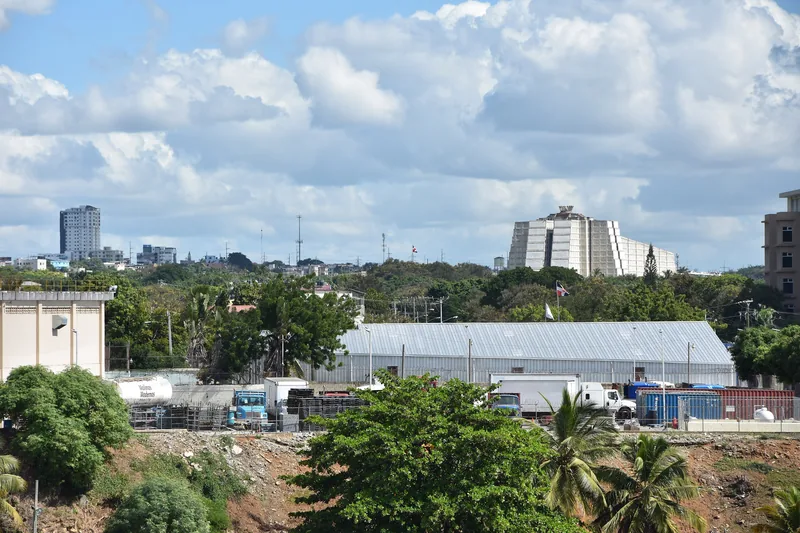
The natural order is lakes first, monument second: get to Los Tres Ojos early to beat the tour crush, then walk or ride the short distance to the Faro afterward, by which time the light and the heat are climbing and a large indoor-ish monument is a reasonable place to be. Reverse it if the Faro's opening hours push you that way. Either sequence works, and both sit on the same side of the river.
What else is nearby
The eastern side of the Ozama holds a few more things if you want to extend the morning further, though none is essential.
- Parque Mirador del Este. The large green park that contains Los Tres Ojos is a pleasant, shaded expanse in its own right, popular with local families and joggers, and a fine place for a short walk to stretch the drive out. It is a city park rather than a wilderness, but it is a genuine bit of green.
- Acuario Nacional. The national aquarium sits out on the eastern coast, and its centerpiece is a clear tunnel you walk through while sharks and rays pass overhead. It is fine, and children love it, but it is a longer haul and a modest attraction, so add it only if you are traveling with kids who need a win.
- Los Tres Ojos and the Faro together are really the core of what the eastern district offers a short-stay visitor. If your time is tight, do those two and head back across the river to the Colonial Zone for lunch rather than trying to chain a third stop onto the end.
For a fuller menu of what you can reach from the capital in a day, from these close-in sights to the beaches down the coast, see our guide to the best day trips from Santo Domingo.
What to bring
You do not need much for a visit this short, but a few things make it better.
- Shoes with grip. The steps and the paths near the water can be wet and uneven. Trainers or proper sandals with a real sole beat flip-flops here.
- Small cash in pesos. For the entry fee, the raft operator's tip, and any informal guide you decide to take. Cards are not reliably accepted.
- A camera or a charged phone. The light in the sinkhole is the whole point, and it changes from lake to lake. The open fourth lagoon and the first sulfur lake are the strongest shots.
- Water and light layers. It is cooler underground than up top, pleasantly so, but you come back up into the heat, so a bottle of water is smart, especially if you are chaining on the Faro afterward.
- Not a swimsuit. Worth repeating: you cannot swim in the lakes. This is a look-don't-touch site, so leave the towel at home.
Skip the drone, since flying one inside a protected cavern full of other visitors is neither allowed nor kind, and skip any expectation of a big gift shop or café scene. There are usually a few vendors around the entrance, but the site is a natural attraction, not a resort complex. Bring your own water and you are set.
Is it worth it? An honest verdict
Yes, with the expectations set correctly. Los Tres Ojos is worth it because it is cheap, close, quick, and genuinely unlike anything else near the old city. The descent into the cool green light, the still turquoise pools, and above all the low-tech charm of being pulled across the water on a hand-hauled raft add up to one of the most memorable short outings in Santo Domingo. Hour for hour and peso for peso, it is one of the best-value things you can do in the capital.
Where people go wrong is treating it as a half-day destination and arriving at the worst possible hour. Give it forty-five minutes to ninety, go early or late to dodge the tour buses, and pair it with the Faro a Colón so the trip across the river carries its weight. Do that and you will leave delighted. Turn up at eleven in the morning on a cruise day expecting a two-hour wilderness experience and you will leave underwhelmed and jostled. The site has not changed; the timing has.
Go at opening, give it an hour, take the raft, and pair it with the Faro next door. Do that and Los Tres Ojos is one of the easiest wins in Santo Domingo.
It is also, importantly, the kind of sight that only makes sense if you are based in the city rather than out on a beach two hours away. From a resort in Punta Cana, Los Tres Ojos is a long, tour-bus day trip you will probably skip. From the Colonial Zone it is a twenty-minute ride you can fold into a single morning and still be back for lunch on a plaza. That difference, between the capital as a base and a beach compound as a base, is the whole argument of this site, and it is worth saying plainly. The three-day and the deeper city itineraries lean on exactly this: that the best of Santo Domingo, the cave lakes included, is a short hop from a bed in the old town. See how it fits a set route in our three-day Santo Domingo itinerary.
Using the Colonial City as your base
Everything about Los Tres Ojos gets easier when you are staying inside the old city. The ride out is short, the return is simple, and the whole excursion slots into a morning without eating a day. You wake up a few blocks from Parque Colón and the cathedral, order a car, and twenty minutes later you are walking down into a limestone cavern on the far side of the river. By early afternoon you are back among the colonial streets for lunch, a coffee, and the long golden evening on the Malecón.
That is the case for staying in the real colonial city rather than a resort bubble on a distant coast. The capital puts the strange, the historic, and the beautiful all within a short ride, and the cave lakes are a small perfect example of it. When your base is the old town, a sight like Los Tres Ojos stops being a major logistical expedition and becomes a spontaneous morning you decide on over breakfast.
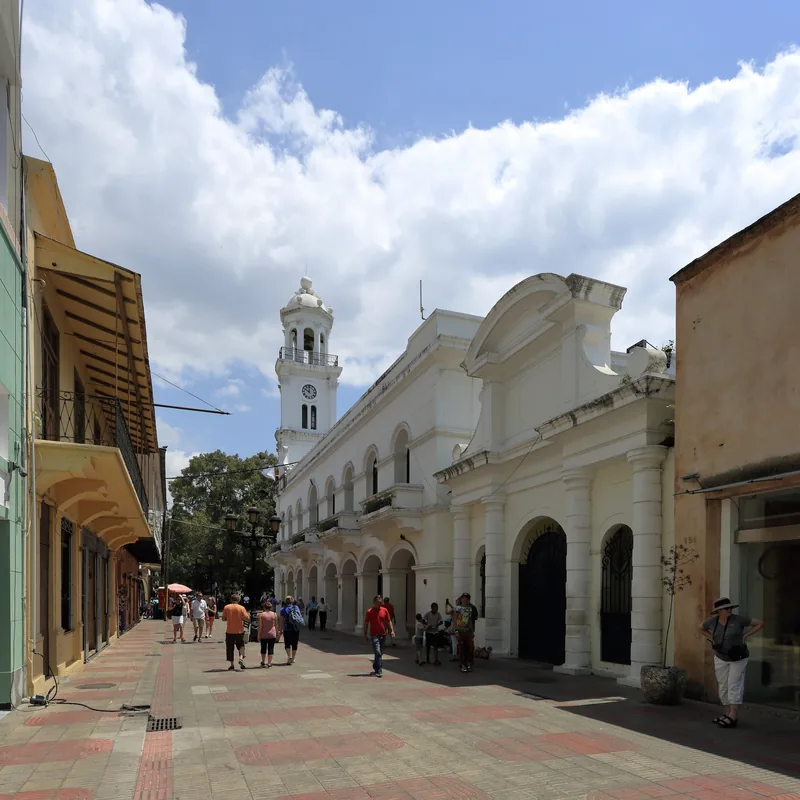
That is exactly why we host where we do. The Residence is Penthouse Pallazzo, a three-suite penthouse on the top floor of a 1760s colonial townhouse in the heart of the Zona Colonial, a short walk from the cathedral, Parque Colón, and the Plaza de España, with a covered hacienda-style gallery and a roof terrace facing the Caribbean and the Montesinos monument on the Malecón. It sleeps six across three bedroom suites, and it puts you a twenty-minute ride from the cave lakes and a two-minute walk from the best of the old city. When you are ready, you can book it on Airbnb, where guests have left ninety-six reviews and a perfect score for location. Stay in the first city of the Americas, use it as your base, and Los Tres Ojos becomes what it should be: an easy, cheap, lovely hour, and just one of the many reasons to skip the resort and sleep in the real colonial city instead.