Santo Domingo Itinerary: 3 Perfect Days
August 2026 · 22 min read
Three days is exactly enough, if you plan them right
A good Santo Domingo itinerary does one thing well: it puts you inside the old city and keeps you there, on foot, long enough to stop reading plaques and start reading the street. Three days is the sweet spot. Day one is the colonial core, walked slowly. Day two pushes east to the cave lakes and back along the sea. Day three slows down again, with a market, a long lunch, and a morning you do not rush. You can see the whole first city of the Americas in that time, eat well, get one afternoon near the water, and still have room to sit still.
This plan assumes you are based in the Zona Colonial, the walled colonial quarter that Santo Domingo grew out of in the early 1500s. That matters more than it sounds. If you stay in the old town, most of day one and day three happen on your feet, from your front door, and the city stops being a checklist of monuments and becomes the place you are living for three days. If you are out by the airport or in a modern district, you will spend those days commuting into the very neighborhood other people simply walk out into. Base yourself right and the itinerary below is almost free of taxis.
What follows is hour by hour, but treat the clock as a suggestion. The point is the order and the logic: cool mornings for walking, hot early afternoons for shade and long lunches, golden hour saved for whichever rooftop or seawall you have earned. Ride apps work well here, so I will tell you exactly when to open one and when to keep walking. If you want the deeper background on the neighborhood before you arrive, the Zona Colonial complete guide covers the streets, the history, and where things are; this piece is the on-the-ground schedule.
How to use this itinerary
A few ground rules make the three days flow instead of fighting you.
- Mornings are for walking. Santo Domingo is hot by late morning and hotter by two. Be out the door by nine when the stone is still cool and the light is good. The heavy sightseeing all lives in the first half of each day.
- Early afternoon is for shade and food. From roughly one to three, sit down. Long lunch, cold drink, air conditioning or a shaded courtyard. This is not lost time. It is how locals do the day and how you avoid wilting.
- Evenings are for the plaza and the terrace. The old city gets its best light and its best mood after five. Save something beautiful for then.
- Open Uber, not a map to a taxi stand. Ride apps are cheap, plentiful, and safe in the city, and they spare you the fare negotiation. Most hops inside town run a few US dollars. I will flag the two or three moments across three days when you actually need a car.
- Carry small cash and water. Many colmados, street vendors, and small museums are cash-first. A bottle of water and a few hundred pesos in small notes solve most problems.
One more thing. This itinerary is built to be swapped. Rain, a closed museum, a slow morning that runs long: none of it breaks the plan, because every block below has an alternative later in the article. Read the rain-day section before you need it.
Getting oriented: the shape of the old town
Before day one, spend two minutes fixing the map in your head, because the Zona Colonial is small and legible and you will not want to stare at a phone the whole time. Picture a rough rectangle sloping down toward the Río Ozama on its eastern side. Calle Las Damas runs along that eastern edge near the river, and the Alcázar de Colón and Plaza España sit at its northern end. The pedestrian spine, Calle El Conde, cuts east to west across the middle of the rectangle, from Parque Colón by the cathedral out to the Puerta del Conde at the old western wall. South of all of it is the sea and the Malecón. North, past Avenida Mella, is the Mercado Modelo and the busier modern city beyond the old walls.
Fix those four edges (river to the east, sea to the south, Calle El Conde through the middle, the market to the north) and you will almost never be lost. Distances are short. Corner to corner of the quarter is about a fifteen-minute walk, and everything on days one and three happens inside this rectangle. That compactness is the whole reason a walking-first itinerary works here in a way it would not in a sprawling capital: you are never more than a few blocks from the next thing, a bench, a coffee, or home.
Day 1: The colonial core, on foot
Day one never leaves the old town, and it barely uses a car. This is the day the city introduces itself.
Morning: Calle Las Damas and the first street in the Americas
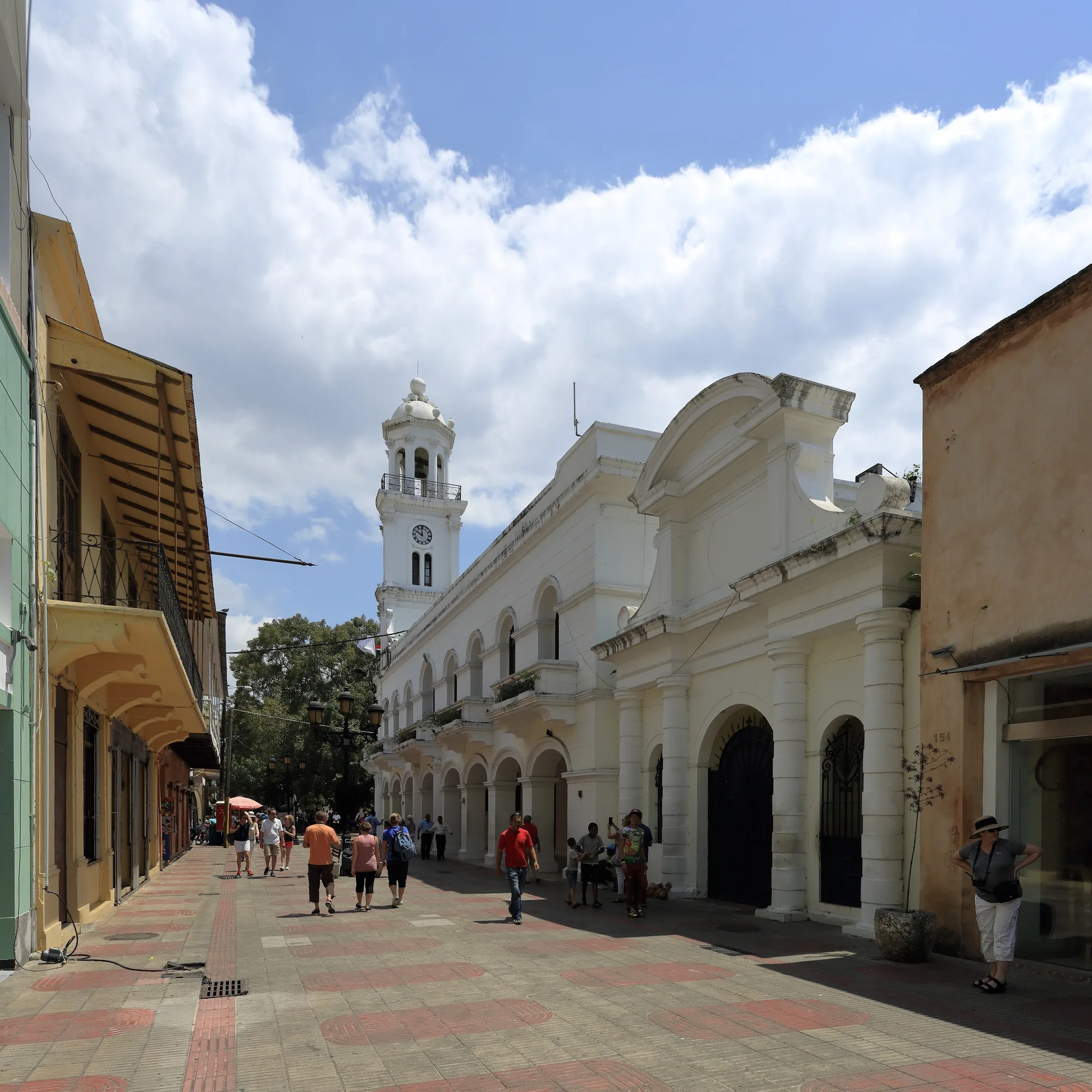
Start early with coffee somewhere in the quarter, then walk to Calle Las Damas, the oldest paved street in the Americas, laid out in the 1500s. It runs a short, straight, shaded line past some of the most important buildings in the country, which is why you start here: in three blocks you get your bearings and half your day-one sights.
Work south to north and give each of these real time rather than a photo and a shrug:
- Fortaleza Ozama, the oldest European military fortress in the Americas, with the Torre del Homenaje standing over the mouth of the river. Climb it. The view down to the water and back across the rooftops is the orientation you want on your first morning.
- The Panteón de la Patria, a former Jesuit church now holding the remains of national heroes, with a soldier on permanent guard.
- Casa de Bastidas and the other early stone houses, worth slowing down for even when they are just facades and courtyards.
Then arrive, on foot, at the building that anchors the whole neighborhood.
Late morning: Alcázar de Colón and Plaza España
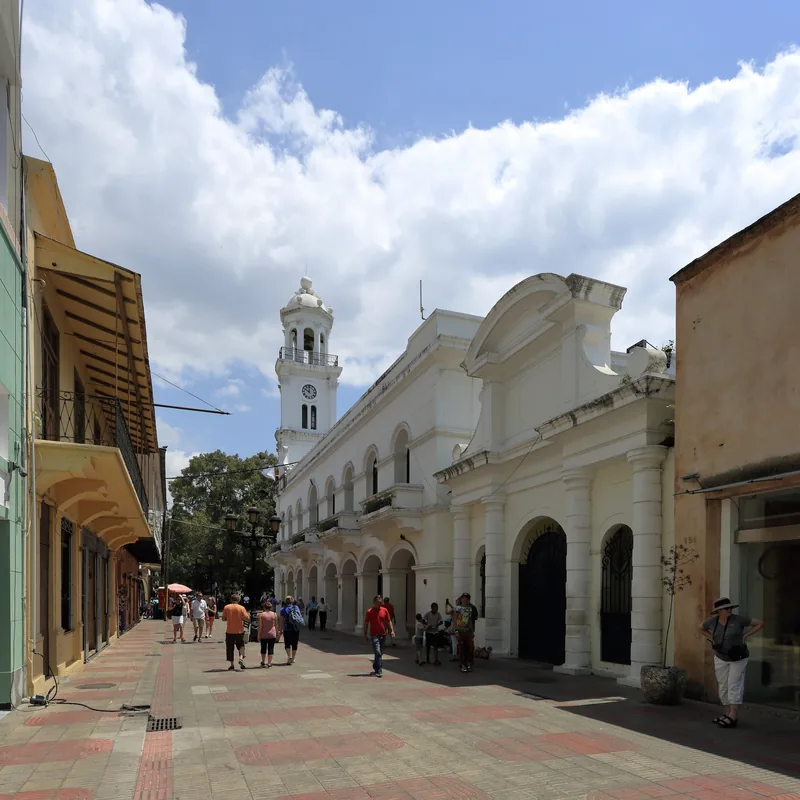
At the top of Calle Las Damas sits the Alcázar de Colón, the coral-stone palace built for Diego Colón, son of Christopher Columbus, in the early 1500s and now a museum of the period. It opens onto Plaza España, the wide plaza that becomes the social heart of the quarter at night. In the morning it is calm and photographs beautifully, with the palace on one side and the old row of arches, Las Atarazanas, on the other.
Give the Alcázar an hour. It is one of the few places where the furniture, tapestries, and rooms actually let you picture the people who ran a colony from this spot. Check current hours before you go, since museum times shift, but mid-morning is almost always safe. If you want the full landmark-by-landmark breakdown of what you are looking at across these blocks, keep the Santo Domingo landmarks guide open on your phone as you walk.
By now it is past noon and the sun means it. Time to sit.
Early afternoon: lunch and the cathedral
Walk five minutes inland to the streets around the cathedral and stop for a proper Dominican lunch. This is the moment for la bandera, the everyday national plate of rice, red beans, stewed meat, and a little salad, or for a sancocho if the kitchen has it. Eat slowly. You have walked a lot of stone.
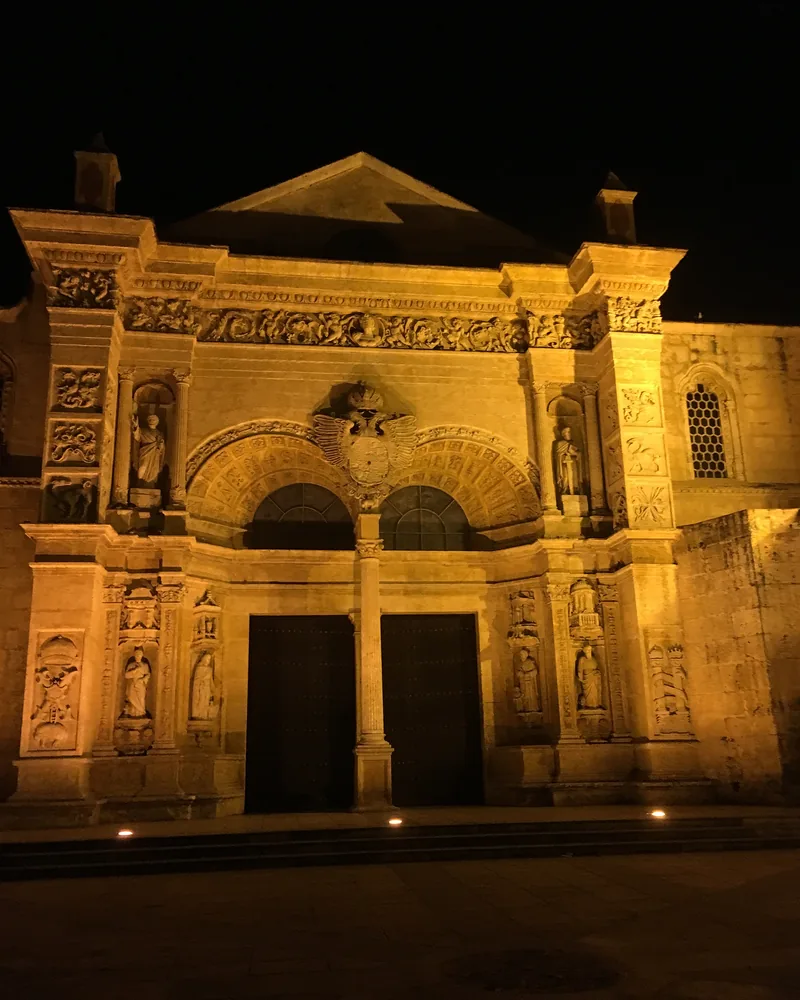
Afterward, when the worst of the heat is breaking, visit the Catedral Primada de América, the first cathedral built in the Americas, begun in 1512. It is a working church and a genuinely moving interior of vaulted stone and side chapels. Dress modestly, keep your voice down, and give it twenty quiet minutes.
Step out of the cathedral into Parque Colón, the shaded square in front of it, and buy a coffee or a fresco from a vendor. This is the best people-watching in the city: shoeshine chairs, pigeons, old men arguing politics, tour groups getting their photo under the Columbus statue. Sit for half an hour and let the afternoon pass.
Evening: Calle El Conde and Plaza España at night
As the light softens, walk Calle El Conde, the pedestrian spine of the old town, from Parque Colón toward the Puerta del Conde and Parque Independencia at the western end. It is all street life: bookshops, amber and larimar sellers, ice cream, buskers, kids on bikes. Browse, do not rush, and buy your larimar here rather than at the airport if you want the real thing at a fair price.
Then double back east for dinner around Plaza España, where the restaurants along the Alcázar side put tables out under the arches and the plaza fills with families and couples after dark. This is the postcard version of the Zona Colonial at night, and it earns it. If you would rather have a fuller list of where to eat than the two or three places you will stumble on, the Colonial Zone restaurants guide sorts the tourist traps from the kitchens locals actually use.
End the night back at the house. If you are staying somewhere with a terrace, this is the first evening you will understand why that matters.
Day 2: Cave lakes, the Malecón, and water
Day two is the one day you use a car with intent. It swings east out of the old town in the morning, comes back along the sea, and gives you an afternoon choice: a real beach or a great museum, depending on your mood and the weather.
Morning: Los Tres Ojos
Open Uber and go to Los Tres Ojos, the cave-lake park about twenty minutes east of the Colonial Zone. The ride is short and cheap, and a rental car buys you nothing here.
Los Tres Ojos, the Three Eyes, is a limestone sinkhole system where three open-air lakes sit at the bottom of a collapsed cave, with a fourth reachable by a small hand-pulled raft. Stone stairs take you down into the caverns, the air drops several degrees the moment you descend, and the water glows an unreal mineral blue and green under the rock. It is the single most photogenic half-day near the city and the thing guests mention most.
Go early, ideally right at opening, for two reasons: the light coming down into the caves is best in the morning, and you beat the tour buses that arrive mid-morning from the resort towns. Budget an hour to ninety minutes. Wear shoes with grip, since the stairs are damp, and carry small cash for the entrance and the raft. For the full walk-through of the caves and how to do them without a guide, the Los Tres Ojos guide has the details.
The choice: beach afternoon or museum afternoon
From Los Tres Ojos your day forks. Pick one before you leave the park so you can point your driver in the right direction.
Option A, the beach afternoon. If the sky is clear and you want salt water, continue east to Boca Chica, about 35 minutes from the old town. It is a shallow, reef-protected bay with flat turquoise water, and it is a lively, local, unpretentious beach: plastic chairs, music, families, and beach kitchens frying fish. Order pescado frito con tostones from one of them, take a chair for a few dollars, and swim. Weekday afternoons are far calmer than weekends. This is not a manicured resort beach and it is not trying to be, which is exactly why it is worth the trip. Uber back to the Colonial Zone in the late afternoon.
Option B, the museum afternoon. If it is hot, gray, or you simply prefer culture to sand, skip the beach and head back toward the city center to the Plaza de la Cultura, the cluster of national museums northwest of the old town. The Museo del Hombre Dominicano, on the country's Taíno and African roots, and the Museo de Arte Moderno are both strong and both air-conditioned. Pick one, not both; two museums in an afternoon is how you stop enjoying either. This is also the smarter call if rain is threatening.
Either way, aim to be back near the sea by late afternoon.
Evening: the Malecón at golden hour
The Malecón, officially Avenida George Washington, is the broad seafront boulevard running along the Caribbean just south of the old town. The water here is for looking at, not swimming, but at golden hour the whole strip turns gold and the breeze finally arrives. Walk a stretch of it, past the Obelisco and toward the Monumento a Fray Antonio de Montesinos, the tall bronze friar on the seawall who raised the first public protest against the enslavement of the Indigenous people in 1511. It is one of the most quietly powerful monuments in the country and it faces straight out to sea.
Have a drink at one of the seafront spots as the sun goes, then decide how much night you want. The Malecón has the big, loud, late nightlife; the Zona Colonial has the prettier, more walkable evening. On a three-day trip I would take a drink on the Malecón and dinner back in the old town, but you have earned either.
Day 3: Markets, food, and a slow terrace morning
Day three is deliberately unhurried. After two big days on your feet, this one is about eating well, buying the few things worth taking home, and giving yourself a morning that is not on a schedule.
Slow morning: the terrace, then coffee
Do not set an alarm. Start day three upstairs, wherever you are staying, with coffee and the city waking up below you. If your place has a roof terrace or gallery facing the old town and the sea, this is the morning to actually use it, before the heat, with a cup of strong Dominican coffee and no plan for an hour. It is the part of the trip people remember and the part no resort day can give you, because a resort keeps you inside its own fence and the Zona Colonial hands you the real city over the rooftops.
When you are ready, walk out for a proper Dominican breakfast: mangú, the mashed green plantain, with fried cheese, salami, and eggs, the classic "tres golpes." A colmado or a simple comedor does this better than any hotel buffet.
Mid-morning: the Mercado Modelo and the artisan streets
Walk or take a short Uber to the Mercado Modelo, the covered market north of Calle El Conde on Avenida Mella. It is crowded, loud, and a little chaotic, and that is the point. This is where you buy larimar and amber, Dominican coffee and cacao, mamajuana bottles, cigars, and the woodwork and paintings that fill the stalls. Prices are negotiable and expected to be; smile, take your time, and never buy from the first stall. Keep your bag in front of you and your phone in your pocket, the ordinary caution of any busy market anywhere.
If the Mercado Modelo is more intensity than you want, the artisan shops along Calle El Conde and the streets around the Alcázar sell the same crafts in a calmer setting for a bit more money. Either way, this is your souvenir morning, done before the midday heat.
Long lunch and an easy afternoon
Make lunch the centerpiece of day three. Go back to whichever kitchen you liked best from the first two days, or try one more thing on the list: a slow sancocho, the rich seven-meat stew that is Sunday food here, or fresh seafood if you are near the water. This is the meal to linger over.
Spend the afternoon lightly. Options, in no particular order:
- The parts of the old town you missed. Almost nobody walks the whole quarter in two days. The Iglesia y Convento de los Dominicos, the Ruinas del Hospital San Nicolás de Bari (the first hospital in the Americas, now a striking ruin), and the quieter southern streets reward a slow loop.
- A rum and cigar sit-down. The Dominican Republic makes some of the best of both. A shaded spot with a good rum and a hand-rolled cigar is a legitimate way to spend a Caribbean afternoon.
- Nothing at all. Back to the terrace, a book, a nap. Three days is enough to earn one genuinely empty afternoon.
If you still have energy and want ideas beyond this list, 25 things to do in Santo Domingo is the fuller menu to pull from.
Last evening: Plaza España, one more time
Spend your final evening where you spent your first, back at Plaza España with the Alcázar lit up, or on Calle El Conde with an ice cream, watching the old city do the thing it does every night. You will have walked most of these streets three times by now, and that is when a place stops being a destination and starts feeling like somewhere you know. That is the whole argument for three days in one city instead of three cities in three days.
Rain-day swaps
Santo Domingo rain tends to come hard and leave fast, often a heavy afternoon burst rather than an all-day gray. Still, the wet season runs roughly May to November, and a soaked day can land on any of these three. Here is how to bend the plan without losing it.
- Rain on day one? The colonial core is unusually rain-friendly because so much of it is indoor or arcaded. Front-load the museums: the Alcázar de Colón, the cathedral, the smaller house-museums, and the arcades of Calle El Conde, which keep you dry between shops. Save the open walking for the clear spells.
- Rain on day two? Take Option B without hesitation. The Plaza de la Cultura museums are the correct rainy-day move, and Los Tres Ojos is partly sheltered inside the caves, so a morning there still works under cloud. Just skip Boca Chica; a lively local beach in the rain is a wet plastic chair and nothing more.
- Rain on day three? This is the easiest one to save, because day three was already slow. Move the terrace coffee indoors, make lunch longer, and turn the souvenir shopping into the main event. The Mercado Modelo is covered.
The general rule: when it rains, pull the indoor blocks forward and push the walking back. Nothing in this itinerary has to happen on a specific half-day, which is the point of building it in swappable pieces.
Getting around: walking, Uber, and the guagua
Your legs do most of the work on this trip, and that is by design.
- Walking covers essentially all of days one and three. The Zona Colonial is compact, flat, and made for feet. Wear real shoes; the cobbles are pretty and unforgiving.
- Uber and ride apps handle the few longer hops: out to Los Tres Ojos, on to Boca Chica, back from the Malecón late at night. They are cheap, reliable, and safe in the city, and using an app means the price is set before you get in. This is the way to move around town after dark, rather than flagging a street cab.
- The guagua, the local shared minibus, is how Dominicans travel between towns for very little money. It is a real experience and worth doing once if you are curious, though for a tight three-day trip inside the capital the ride apps are simpler. Save the guagua for the day you extend the trip.
You do not need a rental car for any of the three days above, and in the old town a car is a liability: parking is scarce, the streets are narrow and one-way, and everything worth seeing is a walk. Rent a car only if you extend the trip into the countryside, and even then think twice, because long-distance coaches and hired drivers cover a lot of the island more comfortably than a self-drive does.
What three days actually costs
Rough ranges, in US dollars, so you can budget with your eyes open. Prices move, so treat these as ballpark and check current rates before you commit.
- Museum and site entries are modest, often a few dollars each, occasionally up to around ten for the headline sites. Budget maybe 20 to 40 dollars per person across three days if you see most of them.
- Los Tres Ojos is a small entrance fee plus a little cash for the raft. Under ten dollars per person, plus the two short Uber rides.
- In-town Uber rides run a few dollars each. Even the longer hop to Boca Chica is usually in the low double digits. Ten to thirty dollars a day covers all your riding on the busiest day.
- Food spans a wide range. A colmado breakfast or a plate of la bandera can be a handful of dollars; a sit-down dinner on Plaza España with drinks is more like 20 to 40 per person. You control this dial completely.
- Boca Chica costs a beach chair and lunch, a few dollars for the chair and maybe 10 to 15 for the fried fish and drinks.
Add it up and three days of sightseeing, transport, and food, excluding your room, lands comfortably in the range of a modest city break rather than a resort one. The single biggest lever is where you stay, and staying inside the Zona Colonial buys you the walking days that keep the rest of the budget low. If you are still weighing the old city against an all-inclusive, the math and the experience both point the same way for this kind of trip: the resort bundles everything into one nightly price and keeps you inside its fence, while the old city lets you spend where you want and walk out into something real.
Extending to five to seven days: Samaná or the southwest
Three days does the capital properly. If you have five to seven, do not add a fourth museum day. Add a coast. Santo Domingo makes a genuinely good base, and two very different Dominican Republics sit within reach of it. Pick one; trying to do both in a week is how you spend the week in a car.
Add the Samaná Peninsula (the green, dramatic option)
Samaná is the northeast peninsula, and it is the one most people mean when they picture the wild, beautiful Dominican Republic: jungled hills falling into the sea, coconut coast, and some of the best beaches in the Caribbean. From Santo Domingo it is roughly a two-to-three-hour drive northeast, and the modern toll highway makes it painless. Coaches and shared vans run the route if you would rather not drive.
Base yourself around Las Galeras or Las Terrenas and give it two or three nights. From there:
- Playa Rincón, near Las Galeras, is regularly called one of the best beaches in the Caribbean, and unlike a packaged resort strand it is a long, wild, palm-backed bay you reach by boat or a rough road. This is the beach that makes the Punta Cana resort beaches look ordinary, and it is worth the effort to see why. The Playa Rincón guide covers how to get out to it.
- Whale season, roughly mid-January to mid-March, brings thousands of humpbacks into Samaná Bay, one of the great wildlife spectacles anywhere. If your trip lands in that window, this is the reason to choose Samaná over everything else.
- Salto El Limón, a waterfall you reach on a short, muddy hike or on horseback, is the easy inland half-day.
If Samaná is the direction you lean, the Samaná Peninsula guide will help you shape the extra days and pick between the two towns as a base.
Add the southwest (the raw, empty option)
The southwest is the road less taken, and it is the DR at its most rugged and least developed. It is a longer haul from the capital, three to five hours depending on how far you push toward Barahona and Pedernales, and it rewards travelers who want emptiness over amenities.
The prize is Bahía de las Águilas, a long arc of pale, undeveloped sand inside a national park near the Haitian border, reached by boat from La Cueva. There are no resorts, no vendors, and almost no people, which is the entire point. Paired with the mountain-and-sea road down through Barahona, with its pebble beaches where rivers meet the ocean, it is the most cinematic drive in the country. This half of the island is genuinely wild, so read the Bahía de las Águilas guide and plan the logistics before you go; it is not a spontaneous afternoon the way Boca Chica is.
Between the two, choose by temperament. Samaná if you want lush and lively with world-class beaches and easy access. The southwest if you want stark, empty, and quiet, and you do not mind working for it.
Before you go: weather, money, and staying smart
A short practical brief so nothing on the three days above catches you out.
When to visit
Santo Domingo works as a city break all year, which is not true of a beach-only trip. The dry season, roughly December to April, is the classic window: warm, less rain, and the busiest. The wetter months, May to November, bring short heavy bursts more often than all-day gray, and the old town's arcades and museums keep you moving through them. The Atlantic hurricane season officially runs June to November, with the real risk concentrated in August to October, though the capital is rarely hit hard and a passing system usually means a wet day or two rather than a ruined trip. If you can choose, the shoulder weeks of late April, May, and November give you decent weather and thinner crowds.
Money and tipping
The currency is the Dominican peso, and cash still rules a lot of the old city. Carry small notes for colmados, street vendors, the Mercado Modelo, and the entrance and raft at Los Tres Ojos. Cards work fine in sit-down restaurants, hotels, and larger shops, and ATMs are common around Calle El Conde. Restaurants typically add a service charge, the "propina legal," to the bill, and it is normal to leave a little extra on top for good service. Change money at a bank or ATM rather than a street changer, and keep your day's cash in a couple of pockets rather than one fat wallet.
Connectivity and staying smart
Pick up a local SIM or an eSIM, cheap and easy to arrange at the airport or a phone shop, because this whole itinerary leans on ride apps and maps. As for safety, the Zona Colonial is one of the most walkable and best-policed parts of the country, busy and pleasant into the evening around El Conde and Plaza España. Use the ordinary sense you would in any city: keep your phone put away in the crowded market, do not flash valuables, and take an Uber rather than walking alone down empty streets very late at night. This is a living capital rather than a sealed resort compound, and that is exactly the point of coming here.
Where to base all of this
Everything above runs on one assumption: that you wake up inside the old city. That is what turns Santo Domingo from a place you visit into a place you briefly live. When your front door opens onto the same stone streets as the cathedral and the Alcázar, days one and three barely need a car, and every evening ends with a short walk home instead of a commute.
That is the case for a base like the Penthouse Pallazzo residence, the top-floor suites of a 1760s colonial townhouse in the heart of the Zona Colonial, with a covered gallery and a roof terrace facing the Caribbean and the Montesinos monument on the Malecón. It sleeps six across three suites, which suits a family or two couples doing exactly this itinerary, and it puts the terrace mornings of day three within arm's reach of everything on days one and two. You book it directly on Airbnb, where the location score sits at a clean 5.0 for reasons this three-day plan makes obvious.
Plan the three days above, stay in the middle of it all, and let the beaches and the mountains be the day trips they should be. The old city is not the thing you do on the way to the resort. On this itinerary, the old city is the trip.