Playa Rincón: One of the Caribbean's Best Beaches
August 2026 · 24 min read
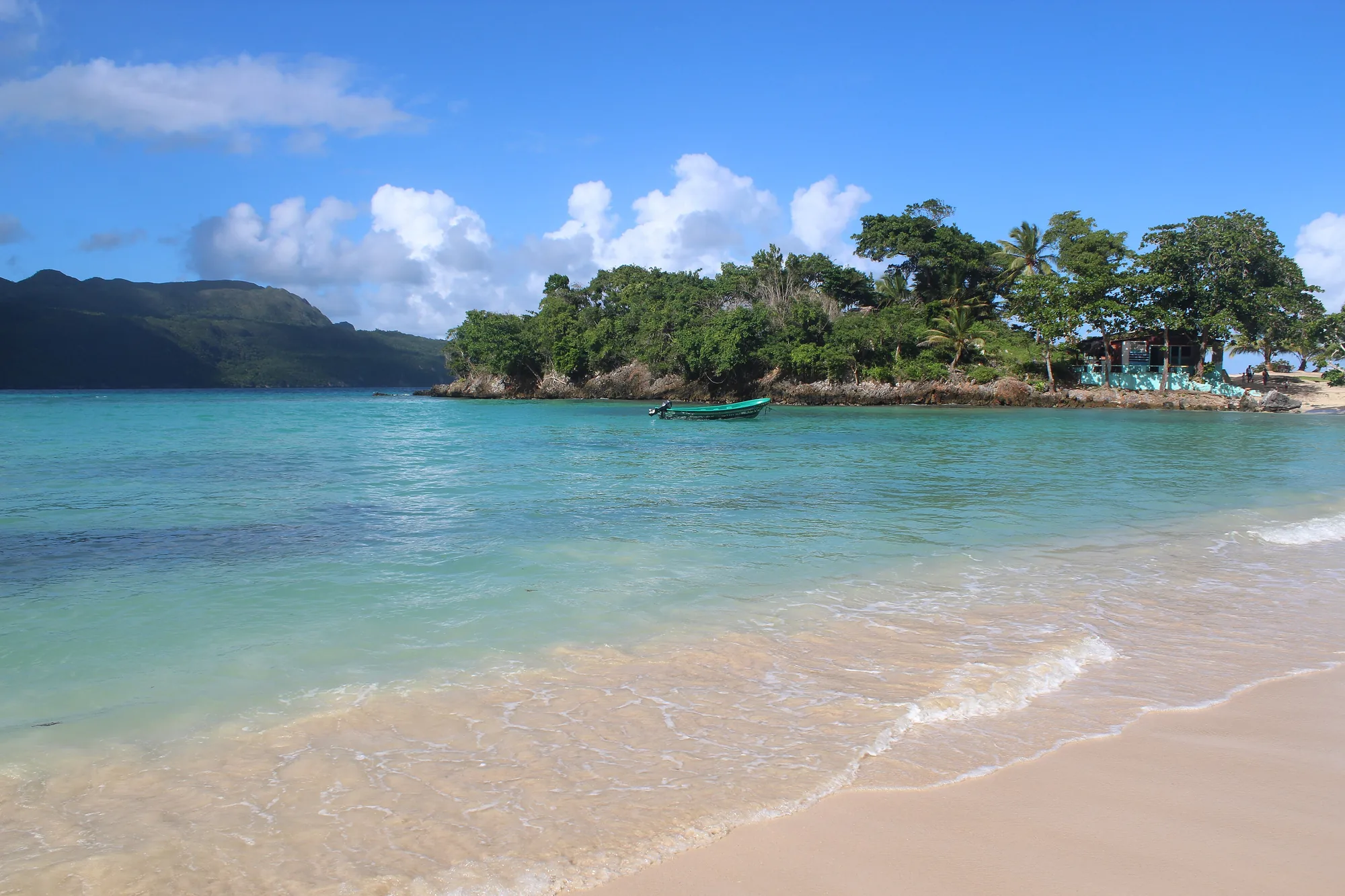
Playa Rincón turns up on serious lists of the best beaches in the Caribbean, and once you have stood on it you stop arguing with the ranking. It is three kilometers of pale sand at the far eastern end of the Samaná Peninsula, backed by an unbroken wall of coconut palms and steep green hills, with a cold freshwater river running out of the jungle at one end and almost nothing built behind it. No resort. No hotel strip. A handful of open-sided fish kitchens under the trees, a few fishing boats pulled up on the sand, and a lot of empty coastline.
That emptiness is the whole point, and it is also the reason this guide exists. Rincón is spectacular precisely because it is hard to reach, and the two ways in, a rough headland track or a short boat ride across the bay from Las Galeras, both take a little planning. This is a single-beach deep dive: what the sand and the water are actually like, where that famous river meets the sea, how to arrive without stress, what to eat when you get there, what to carry because there are almost no services, and how to time your visit so you get the empty version rather than the Sunday-afternoon one. I will also be honest about how it compares to the beaches most visitors fly into, because the comparison is a big part of why Rincón is worth the effort.
One bias to declare up front: I write for a place to stay in the colonial heart of Santo Domingo, and I think the smartest way to see a beach like this is from a real city base rather than a resort compound. More on that at the end. First, the beach.
The beach itself: three kilometers of almost nothing
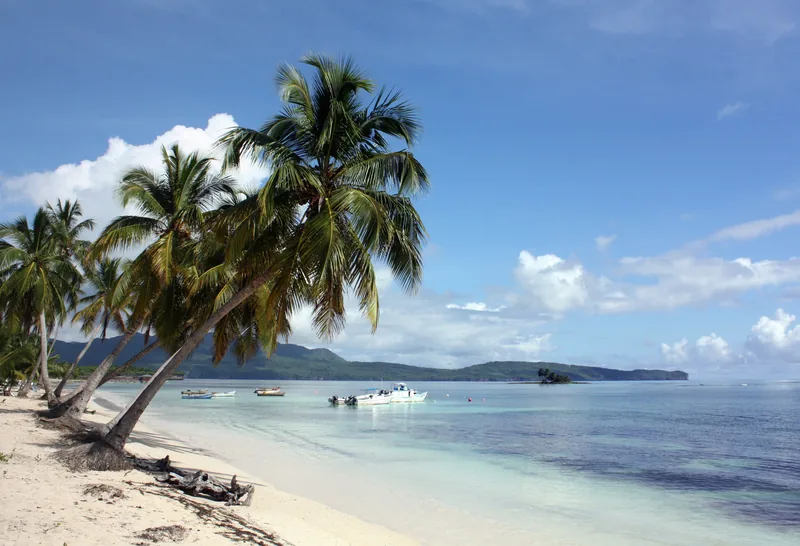
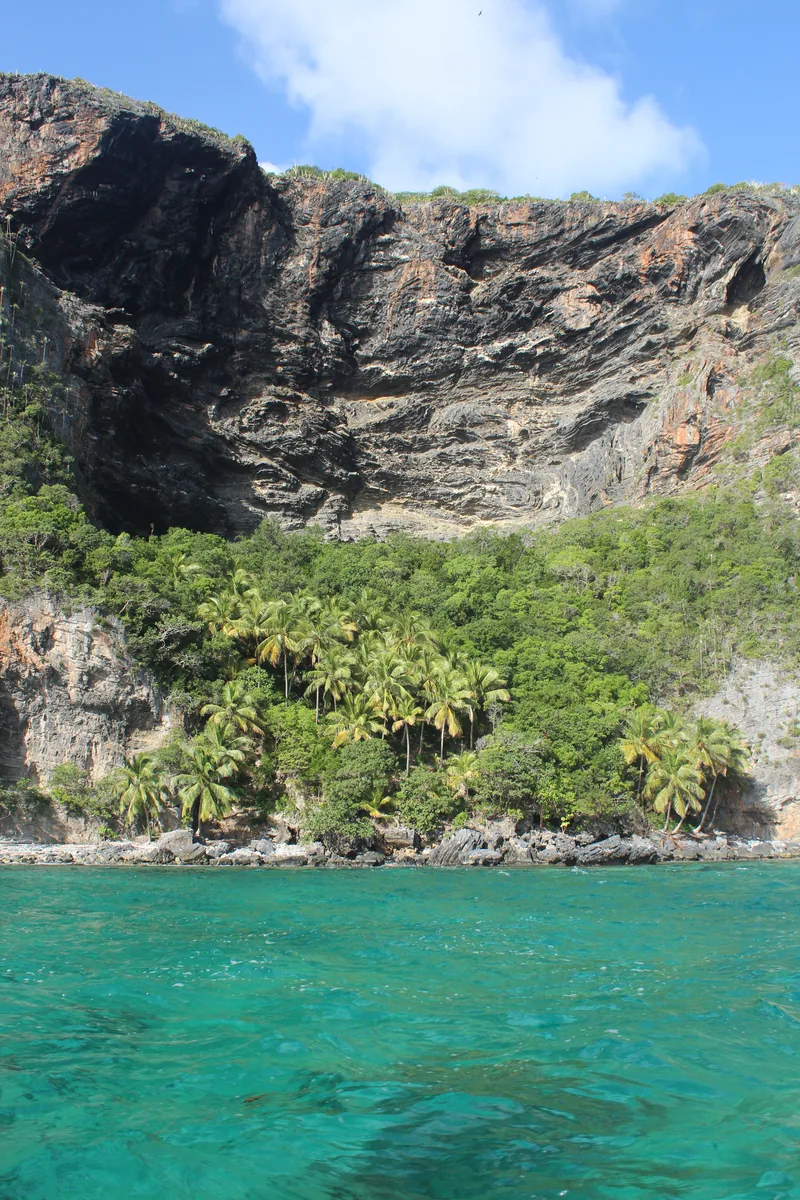
Picture a long shallow crescent that curves for roughly three kilometers between two green headlands. The sand is pale, soft, and wide, with enough depth between the waterline and the tree line that even on a busy day the beach never feels crowded. Behind it, coconut palms grow in a dense, leaning wall, and behind the palms the hills climb steep and green almost straight up from the shore. There is no road running along the back of the beach, no line of buildings, no concrete. What you see when you look inland from the water is more or less what a sailor would have seen off this coast five hundred years ago.
The water grades through the full postcard sequence of colors, clear and shallow and pale turquoise near the sand, then a band of brighter aquamarine, then deep blue where the bottom drops away. Because the bay is partly sheltered by the peninsula's headlands, the sea here is usually calmer than the open Atlantic beaches on the north coast, and one stretch or another is almost always gentle enough for an easy swim. On a flat morning the shallows are glassy. When a swell is running the middle of the beach can pick up some surf, which is worth reading before you let children charge in, but you can nearly always find a mellow corner.
What makes Rincón land the way it does is the ratio of scale to development, which is to say scale to nothing. Most beautiful Caribbean beaches are beautiful in spite of what has been built behind them, a pretty strip of sand fronting a wall of hotels. Rincón is beautiful because nothing has been built behind it at all. The palm line is unbroken for the whole length. The hills are wild. On a weekday out of season you can walk for twenty minutes and count the other people on your fingers. That combination, real scale, clean water, and genuine emptiness, is rare anywhere in the world and close to extinct in the developed Caribbean.
Most famous Caribbean beaches are lovely in spite of what stands behind them. Rincón is lovely because nothing stands behind it.
It is not a manicured beach, and you should not want it to be. Palm fronds and the odd coconut litter the sand near the tree line. Seagrass washes up in patches depending on the season and the wind. A stream cuts across the beach here and there. This is a living coast, not a raked resort frontage, and the small wildness is exactly what you came for. Bring that expectation and you will love it. Turn up wanting sun loungers in tidy rows and a beach bar with a card machine and you will be briefly confused, then, if you have any sense, delighted.
The freshwater river at the far end
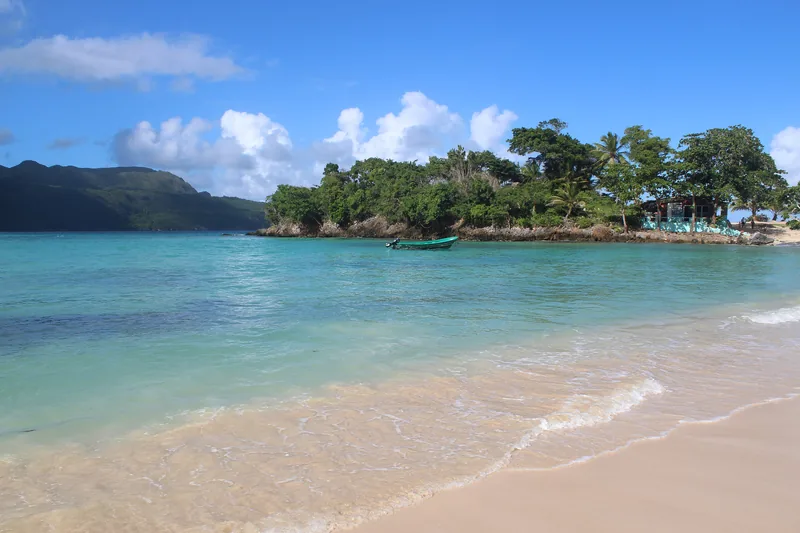
At the eastern end of the beach, where the sand runs up against the headland, a cold freshwater river comes down out of the hills and meets the sea. Locals call it the Caño Frío, the cold channel, and the calm pool where it gathers before it reaches the salt is often just called La Poza, the pool. Whatever name you hear, it is one of the most distinctive things about Rincón and a big reason to walk the length of the beach rather than settle at the first shady spot you find.
The water in the river is genuinely cold, clear, and fresh, a real jolt after the warm sea, and it is startlingly clean because it is coming straight off the forested hills rather than through any town. You can wade and float in the shaded pool where the river widens, rinse the salt and sand off your skin, and then walk twenty steps back into the warm Caribbean. That contrast, cold fresh water and warm salt water within a few meters of each other, is the kind of thing you remember about a beach for years. Overhanging trees keep the pool shaded and cool even at midday, so it doubles as the best natural shade on the whole beach.
A few practical notes on the river. It is a swimming and paddling spot, not a deep one, so treat it as a place to cool off and float rather than a proper swim. Small boats sometimes ferry visitors up the channel a short way into the green tunnel of trees, which is a pretty ten-minute add-on if someone offers it and the price is reasonable. The area around the river mouth is where a lot of the day-trippers cluster, especially the boat arrivals, so if you want the cold plunge and the shade without a crowd, get there early or wander back toward the emptier center and western end of the beach for your stretch of sand.
Because the river is the single best feature at the far end, it also anchors how you plan your day: many people set up somewhere with a view of the water, swim in the sea, and use the Caño Frío as the cool-down and the shade. If you only do one deliberate thing at Rincón beyond lie on the sand, walk to the river.
Getting there: the rough road or the boat from Las Galeras
Here is the part that separates the people who talk about Rincón from the people who actually go. There are two realistic ways onto the beach, and neither is a simple drive-up-and-park. Both start from the small town of Las Galeras, at the very tip of the Samaná Peninsula, which is itself the end of the road in this corner of the country. Get yourself to Las Galeras first, then choose your approach.
By boat from Las Galeras
The boat is the fast way and, on a calm day, the beautiful way. From the public beach in Las Galeras, local boatmen run small open launches around the headland to Rincón, a crossing of roughly twenty to thirty minutes depending on the sea and the boat. You skip the rough road entirely, you get a run along a genuinely gorgeous stretch of coast, and you can often combine the trip with a stop at other beaches you cannot easily reach any other way.
A few rules make the boat painless:
- Agree the price and the return time before you get in. This is a negotiated local service, not a ticketed ferry. Settle the round-trip fare, confirm what time and where they will collect you, and make sure everyone understands it. A shared boat with other travelers is cheaper per head; a private run costs more but goes on your schedule.
- Go in the morning. The sea on this coast is calmest early and tends to build through the day. A morning crossing is smoother, and it also gets you onto the sand before the day-trip crowds.
- Expect to get your feet wet. These are beach-launch boats. You wade out to board and wade in to land, so dry-bag anything you cannot afford to soak, and wear something you can walk into the water in.
- Weather can cancel it. If a strong swell or a squall is running, the boatmen will not go, and they are right not to. Keep a day of slack in your plans so a blown-out morning is not a lost Rincón.
The boat is my default recommendation for most visitors. It is the least effort, the most scenic, and it opens the door to the boat-day loop I describe below.
By the 4x4 road over the headland
The overland route is a partly paved, mostly rough dirt-and-rock track that climbs over the headland from the Las Galeras road and drops down to the western end of Rincón. In a high-clearance vehicle in dry conditions it is a bumpy but doable half-hour or so. In a low-slung rental car, or after heavy rain when the track turns to mud and ruts, it ranges from a bad idea to genuinely impassable. People do get stuck out here, and there is no one to call.
Your sensible options for the road:
- A hired 4x4 with a local driver, arranged in Las Galeras, who knows the track and does it all the time. This is the stress-free version of the overland route.
- An organized tour from Las Galeras or Samaná town that handles the transport and often bundles the beach with lunch. Easy, if less flexible on timing.
- Your own high-clearance vehicle, only if you are comfortable with rough tracks, you have checked recent conditions, and it has not just rained. Do not attempt it in a standard economy rental.
The road has one advantage worth naming: it puts you down near the western end and the fish shacks and lets you stay as late as you like without watching the clock for a boat pickup. If you are the kind of traveler who wants the beach at its emptiest in the late afternoon after the boats have gone, the road (done in the right vehicle) is how you get that.
Getting to Las Galeras in the first place
Both routes assume you have reached Las Galeras, and that is a trip in itself. Las Galeras sits about three and a half to four hours from Santo Domingo, most of it on the modern Samaná highway and the last stretch on slower peninsula roads. That distance is the single most important planning fact about Rincón: it is too far to be a comfortable day trip from the capital. You go to Las Galeras, you sleep there for two or three nights, and you give Rincón a full unhurried day as part of a wider Samaná trip. Trying to bang it out from Santo Domingo and back in a day means eight hours in a vehicle for a few rushed hours on the sand, and you should not do that to yourself.
If you are coming without a rental car, the chain that works is a long-distance coach or van toward Samaná, then local transport out to Las Galeras, then the boat or a hired 4x4 to the beach. Our guide to getting around the Dominican Republic breaks down the coaches, the guaguas, and how the hops connect. For the full picture of the town you will be based in, the beaches around it, and how the boat loops work, see the dedicated Las Galeras travel guide and the wider Samaná Peninsula guide.
The fish shacks: lunch under the palms
You do not need to pack a full lunch for Rincón, because the one real service on the beach is a good one. Toward the western end, under the palms, a small cluster of open-sided beach kitchens grill and fry whatever the fishing boats brought in. This is not a restaurant scene, it is a handful of simple family-run shacks with plastic chairs, a cool box of drinks, and a charcoal fire, and it is one of the best beach lunches in the country.
What to expect on the plate:
- Whole fresh fish, usually fried crisp or grilled, often red snapper or whatever came in that morning, served with the head on the way locals like it.
- Pescado con coco in some kitchens, fish in a coconut-milk sauce that is a Samaná specialty and worth seeking out if it is on offer.
- Tostones and rice, the standard fried-plantain-and-rice accompaniment that comes with almost everything.
- Sometimes shrimp or lobster, priced higher and worth confirming the cost of before you order, since seafood is sold by weight and the "market price" can climb.
- Cold drinks, water, soft drinks, and cold Presidente beer out of the cooler.
Two honest tips. First, prices are higher than you would pay in a town, because everything has to be carried in and there is no competition on an empty beach, so this is not a budget meal, though it is fair for what it is and where it is. Confirm the price of anything sold by weight, especially lobster, before it hits the fire. Second, it is cash only, in pesos, and there is no cash machine within a long way, so bring enough for lunch, drinks, and a tip and then some. Sitting under the palms with a whole fried fish, a plate of tostones, and a cold beer, looking out at that water, is a large part of what makes a day at Rincón feel complete. Do not skip it to save a few pesos.
If you arrive by boat for a half-day and plan to leave before lunch, you can obviously skip all this, but I would build the meal in. It is one of the good things about the place, and the beach earns a full slow day rather than a quick photo stop.
What to bring, because there is almost nothing here
Beyond the fish shacks, Rincón has essentially no services, and that is the deal you are accepting for the emptiness. There is no resort, no shop, no pharmacy, no lifeguard tower, no rental hut with a wall of loungers, and no reliable phone signal in parts of the beach. Treat it like the semi-wild place it is and pack accordingly. Get this list right and the day is perfect; get it wrong and you spend the afternoon squinting, thirsty, and sunburnt.
- Cash in pesos, in small bills. For lunch, drinks, tips, and your boat. No cards, no cash machine, no exceptions.
- Plenty of water. More than you think. It is hot, there is walking, and the only drinks for sale are at the shacks at one end.
- Real sun protection. High-factor reef-safe sunscreen, a hat, sunglasses, and ideally a long-sleeve rash top for swimming. The natural shade is limited to the tree line and the river; the middle of the beach is fully exposed.
- Your own shade if you want guaranteed shade. A beach umbrella or a shade tent is worth carrying if you burn easily or have kids, because you cannot rent one on the sand.
- Water shoes or sturdy sandals. Useful for wading to and from the boat and for the river rocks.
- A dry bag. Non-negotiable if you arrive by boat. It keeps your phone, cash, and camera dry through the wet launch and landing.
- Snacks and any specific supplies, plus anything for children, since there is no shop to duck into.
- A basic first-aid kit and any personal medication. There is no help nearby, so a few plasters, antiseptic, and painkillers cover the small stuff.
- A bag for your rubbish. Carry out what you carry in. This coast stays beautiful because people respect it, and there is no bin service.
None of this is heavy or complicated. It is one full daypack per couple, thrown together the night before in Las Galeras. But the beach genuinely has nothing, so the packing is the difference between a great day and an uncomfortable one.
When to go for empty sand
Rincón is big enough that it never feels truly packed, but the difference between a serene morning and a busy Sunday is real, and timing is entirely within your control. If solitude is what you are after, and at a beach like this it should be, plan around three things: the day of the week, the time of day, and the season.
Time of day
The single most effective move is to go early. The day-trip boats and the tour groups tend to arrive mid-to-late morning and cluster around the river mouth and the fish shacks, then thin out again in the afternoon. Arrive in the first part of the morning, either on an early boat or overland, and you get the beach at its calmest and quietest, with the flattest sea for swimming and the softest light. The late afternoon is the other sweet spot: once the boats have run their passengers back to Las Galeras, the beach empties out again, and the last hours before sunset can be almost private if you have your own transport (the 4x4 road) and are not tied to a boat pickup time.
Day of the week
Weekdays beat weekends, straightforwardly. On Sundays and Dominican holidays, local families come out for the day, especially to the accessible end, and the beach takes on a lively, social, music-and-picnic character. That is a genuinely nice thing to experience once and the opposite of what you want if you came for emptiness. For the quiet version, aim for a weekday.
Season
The broad seasons shape both the crowds and the practicalities:
- December to April is the dry, high season: the most reliable sun, the calmest and most predictable seas for the boat crossing, and the busiest the peninsula gets. This is the safest window if your visit depends on a boat.
- Whale season, roughly mid-January to mid-March, brings thousands of humpbacks into Samaná Bay to breed, which makes a Samaná trip in those weeks one of the best-timed in the country. If you are already coming for the beaches, overlapping with the whales is a rare bonus; see the Samaná whale watching guide for how and when.
- Hurricane season, June through November, brings lower prices and fewer people, and most days are still fine, but the sea is less predictable and a boat day can get blown out. Keep flexibility in your plans in these months.
Put the three together and the formula is simple: a weekday morning in the dry season, arriving early, is Rincón at its emptiest and best. Even in high season, that combination gets you long stretches of sand with almost no one on them.
Make it a boat day: Rincón, Frontón and Madama
If you have come all this way, consider turning the visit into a boat day rather than a single-beach trip, because Rincón is the headline act of a small run of beaches that are only reachable by water and would each be famous on their own anywhere else. Boatmen in Las Galeras will string several together into one morning-to-afternoon loop, and it is one of the best value outings in the country.
The usual cast:
- Playa Frontón, a dramatic cove tucked under a sheer cliff, reachable only by boat or a hot hike through the bush. It has some of the best snorkeling on this coast, with rock and reef close to shore, and it feels genuinely remote.
- Playa Madama, a smaller, shadier horseshoe on the same stretch, calmer and good for a quiet swim and a picnic.
- La Playita, the pretty little beach just outside Las Galeras itself, an easy first or last stop.
- Rincón, the main event, where most loops spend the longest stretch and where you can have that fish lunch.
Arranging one boat for the day and cutting a route through three or four of these beaches means you knock out a genuinely remarkable set of coastline in a single unforgettable outing, snorkeling one cove, swimming another, and lingering longest at Rincón. Agree the full itinerary, the price, and the timings before you leave the dock, and go in the morning for the calmest water. A good boatman will help you plan a sensible route and order for the sea and the light.
Is it really one of the Caribbean's best? An honest verdict
Yes, and I will make the case in plain terms rather than adjectives. What earns Rincón a place on the honest short list of great Caribbean beaches is not any single feature but the combination: real scale, three kilometers of it; water that runs the full range from clear shallow turquoise to deep blue; a wild, unbroken green backdrop with no development; a cold freshwater river you can float in; simple good food under the palms; and, if you time it right, near-solitude. Very few beaches anywhere hit all of those at once, and fewer still do it without a wall of hotels behind them.
The comparison worth making is to the beaches most people actually fly into, because it explains why Rincón is worth the four-hour approach when Punta Cana is a two-hour drive from the capital. The long Punta Cana and Bávaro strand in the east is genuinely good in its own register, kilometers of soft pale sand, warm calm reef-protected water, and every service you could want a few steps away. But it is developed end to end, shaped entirely around the all-inclusive resorts that line it, and it trades character for convenience. The sand is lovely and tame. It has none of Rincón's drama, none of its emptiness, and none of its wildness. You are buying predictability and zero logistics, and paying for it in the sense of being somewhere specific.
Rincón is the opposite trade. You work for it, you carry your own water, and there is not a lounger or a swim-up bar in sight, and in return you get a beach that still looks and feels like the real country rather than a stage set. Neither is wrong. A traveler who wants a lounger, a cocktail, and no thinking should book Punta Cana without apology. A traveler who wants to stand on sand that looks the way this island looked before any of it was built should come to Rincón and consider the effort part of the reward. If you want the full head-to-head, the pieces on Las Galeras versus Punta Cana and the honest Punta Cana beaches guide lay out both sides. Rincón also sits near the top of our overall ranking in the best beaches in the Dominican Republic countdown, and the reasoning there is the same as here: it is the best beach in the country that you can reasonably reach.
The only beach that seriously rivals it for wildness is Bahía de las Águilas in the far southwest, which is arguably even more untouched but sits six to seven hours from the capital in a national park with no road along it. Rincón gives you most of that magic for a fraction of the expedition. That is why, if you are choosing one wild Dominican beach and you do not have a week to give the southwest, Rincón is the answer.
What a day at Rincón actually costs
No invented numbers, because real prices move and you should check current ones locally, but here is the shape of the spending so you can budget and carry the right cash.
- The boat from Las Galeras is the main variable cost, negotiated on the day. A shared boat split with other travelers is modest per person; a private round trip costs more, and a multi-beach boat-day loop more again. Settle it before you board.
- A hired 4x4 with a driver over the road is a comparable negotiated cost, sometimes bundled into a tour with lunch.
- Lunch at the fish shacks is the other real cost, and it is higher than a town meal because of where it is. A whole fish with sides and a drink is a fair mid-range spend; anything by weight, especially lobster, should be priced before you order.
- The beach itself is free. There is no entry fee and nothing to rent, which is exactly why you carry your own water, shade, and supplies.
The pattern is the one that holds all over the country: the spectacular beaches cost you mainly in time and effort to reach rather than in cash once you are there. Bring more pesos than you expect to spend, in small bills, because there is no way to get more on the beach and the shacks and boatmen do not take cards.
Safety, swimming and a few honest cautions
Rincón is a safe and rewarding beach, but it is a semi-wild one, and a few honest notes keep a great day a great day.
- There are no lifeguards. Swim within your depth, keep a close eye on children, and respect the sea when a swell is running. The sheltered ends are usually calm, but the open middle can pick up surf and the occasional current. If it looks rough, swim at the calmer end or stick to the shallows and the river.
- The sun is stronger than it feels with a sea breeze taking the edge off. Reapply sunscreen, use the shade, and do not underestimate a full day of exposure. The most common way to ruin a Rincón day is sunburn.
- Watch for falling coconuts near the tree line. It sounds like a joke and is not; do not set up directly under a laden palm.
- Take your valuables with you if you swim, or leave anything you would hate to lose back in Las Galeras. It is a low-crime, low-key beach, but it is empty and unwatched, so use ordinary sense.
- Mind the boat timing and the weather. If you came by boat, be at the agreed pickup point on time, and build a spare day into your Samaná plans so a blown-out sea does not cost you the beach entirely.
- Carry out your rubbish. There is no bin service, and the beach stays beautiful only because visitors respect it.
None of this should give you pause. Thousands of people have a flawless day at Rincón every week. It simply rewards the small preparation that any remote beach deserves, and punishes the traveler who turns up expecting a managed resort frontage with a first-aid station and a bar. Come prepared and you get one of the great beach days of your life.
Where Rincón fits in a Samaná trip
Because Rincón demands an overnight base, it makes most sense to think of it not as a destination on its own but as the best day of a two-or-three-night Samaná trip run out of Las Galeras. That small town at the end of the peninsula is unpolished, easygoing, and refreshingly unpackaged, with a scatter of guesthouses and restaurants, its own pretty beaches within walking or short-boat distance, and the boatmen who get you to Rincón, Frontón, and Madama.
A natural rhythm looks like this: arrive in Las Galeras and settle in; give Rincón a full slow day, ideally by boat and ideally on a weekday; spend another day on the boat loop to Frontón and Madama, or on the wider peninsula; and, if the season is right, fold in whale watching in Samaná Bay or the hike to the Salto El Limón waterfall inland. That turns the long haul out to the peninsula into a proper trip rather than a single-beach dash, and it means the four hours of driving each way buy you three or four of the finest beaches in the country plus a waterfall and, in season, humpback whales. Planned that way, the effort stops feeling like a cost and starts feeling like the reason the place is still this good.
Using the Colonial City as your base
Here is the argument I promised at the top. Rincón is worth an overnight in Las Galeras, no question, but the wider trip still needs a home, and where you make that home shapes the whole Dominican Republic you experience. The default instinct is to pick one beach, book a resort in front of it, and stay put for a week. For a certain kind of trip that is fine. But it locks you onto one coast, usually the tamest one, and it turns everything else, Rincón included, into a distant excursion you probably never make.
Base yourself in the colonial heart of Santo Domingo instead and the country opens up as a series of trips rather than a single compound. The capital puts you within a day trip or a short hop of most of the coast: the close beaches for an easy afternoon, the east within a day's reach, and Samaná an easy overnight to the northeast when you want to give Rincón and Las Galeras the time they deserve. In between, you come home each evening to a real, living, five-hundred-year-old city rather than a lobby and a buffet line.
Book one resort and you see one beach. Base in the old city and Rincón becomes the crown of a much bigger trip.
That is the thinking behind The Residence, Penthouse Pallazzo: a three-suite penthouse on the top floor of a 1760s colonial townhouse in the heart of the Zona Colonial, with a covered hacienda-style gallery and a roof terrace facing the Caribbean and the Montesinos monument on the Malecón. It sleeps six across three bedroom suites, ride apps reach the door, and you can strike out from it to Samaná for a few nights to do Rincón properly, then come back to coffee on a coral-stone street and long golden evenings over the old town. It is booked through Airbnb, where it carries ninety-six reviews, a strong overall score, and a perfect five for location.
Do Rincón the way it deserves: a weekday morning, by boat, with cash in your pocket and your own water in your bag, a whole fried fish under the palms, and a cold float in the Caño Frío before you head back. Give it a full unhurried day as part of a Samaná trip, and use a base in the real colonial city to make the rest of the country just as easy. That is how you actually get to one of the best beaches in the Caribbean, and how you enjoy everything around it too.