The Best Beaches in the Dominican Republic
August 2026 · 22 min read
The best beaches in the Dominican Republic are not the ones the resorts put on the brochure. The country has more than 1,600 kilometers of coastline, four separate coasts with four separate personalities, and a short list of beaches that belong in any honest ranking of the Caribbean's best. Most visitors never reach them. They land in Punta Cana, spend a week behind a gate on a pleasant, calm, interchangeable strip of sand, and fly home convinced they have seen the Dominican coast. They have seen one version of it, and not the best one.
This guide is a ranked countdown, and I will make the case for every place on it. I will also tell you plainly where each beach sits on the one axis that decides a Dominican beach day, which is character versus convenience. The wildest, most beautiful beaches in the country are the hardest to reach. The easiest ones to reach are the least remarkable. Almost everything below is a negotiation between those two facts, and knowing that in advance is the most useful thing I can give you.
One bias up front, so you can weigh it: I write for a place to stay in the colonial heart of the capital, and I think Santo Domingo is the smartest base in the country because it puts you within a day trip or a short hop of most of these coasts without locking you inside any one of them for a week. More on that at the end. For now, the sand.
How this ranking actually works
I am ranking on the beach itself and the experience of being on it: the water, the sand, the setting, the crowd, and how much the place still feels like the country rather than a stage set built for tourists. I am not ranking on ease. If I did, this list would be upside down.
That is the tension worth understanding before you plan anything. In the Dominican Republic, beauty and effort move together. The two best beaches in the country sit at the ends of the map, one on a roadless stretch of the far southwest, the other at the tip of a peninsula reachable by a rough track or a small boat. The most convenient beaches, the ones a taxi reaches in half an hour, are the ones locals love and photographers politely skip. Neither end is wrong. A honeymooner who wants a lounger, a swim-up bar, and zero logistics should book Punta Cana and enjoy it without apology. A traveler who wants to stand on sand that looks the way this island looked five hundred years ago has to earn it.
So read each entry twice: once for how good the beach is, which is what the ranking reflects, and once for the reachability note, which tells you what you are signing up for. Then match the beach to the trip you actually want.
The four coasts, quickly
The country's beaches fall into four regions, and orienting yourself by coast makes the whole map click into place.
- The Samaná Peninsula (northeast): the wild green thumb of land in the country's northeast, home to Playa Rincón, Las Galeras, Las Terrenas, whale season, and a waterfall or two. The best all-round beach region in the DR.
- The Southwest (Barahona to Pedernales): arid, dramatic, empty, and far. This is where Bahía de las Águilas hides, along with pebble beaches, river mouths, and almost no crowds.
- The North Coast (Puerto Plata, Sosúa, Cabarete): the old tourist coast, breezier and greener, big on watersports, with a few genuinely lovely beaches mixed in with some tired ones.
- The East (Punta Cana, Bávaro, Bayahibe, the islands): the resort machine. Long, calm, palm-lined, warm, and heavily developed, plus the boat-trip islands of Saona and Catalina.
And then there is the capital's own doorstep, Boca Chica and Juan Dolio, which is a category of its own: the closest swimmable water to Santo Domingo, and the honest answer for a half-day rather than a pilgrimage.
1. Playa Rincón, Las Galeras
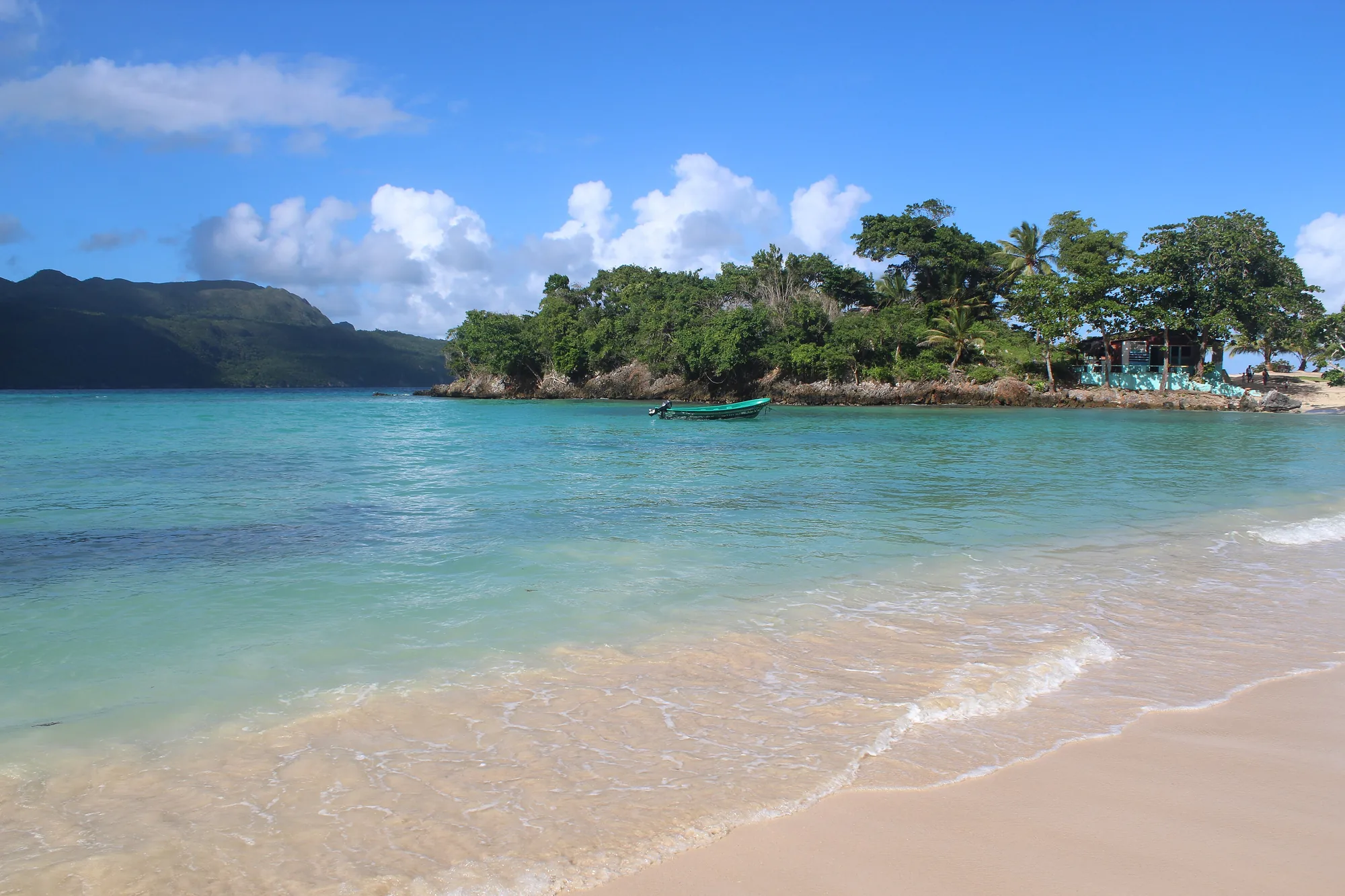
This is the best beach in the Dominican Republic, and it is not especially close. Playa Rincón sits at the far eastern end of the Samaná Peninsula, past the small town of Las Galeras, and it turns up again and again on serious lists of the top beaches in the Caribbean and occasionally the world. When you stand on it you understand why nobody is exaggerating.
It is a long crescent, roughly three kilometers of pale sand backed by a dense wall of coconut palms and green hills that come almost to the waterline. The water grades from clear shallow turquoise to deep blue, and because the bay is partly sheltered, one end is usually calm enough for an easy swim. At the western end a cold freshwater river, the Caño Frío, runs out of the jungle and meets the sea, so you can rinse the salt off in fresh water without leaving the beach. There is no resort. There is no strip of hotels. There are a few simple beach kitchens under the palms serving whole fried fish, rice, tostones, and cold Presidente, and there is a lot of empty sand.
Why it wins
The ranking comes down to setting. Most beautiful Caribbean beaches are beautiful in spite of what has been built behind them. Rincón is beautiful because nothing has been built behind it. The palm wall is unbroken, the hills are green and steep, and the whole place still reads as coastline rather than real estate. On a weekday out of season you can walk for twenty minutes and pass a dozen people. That combination of scale, water, and emptiness is rare anywhere, and in a country this developed it is close to miraculous.
How to reach it
Two ways, and the choice matters:
- By boat from Las Galeras. A short hop across the bay, roughly twenty to thirty minutes, arranged with the boatmen at the Las Galeras public beach. Fastest and prettiest, weather permitting. Agree the price and the pickup time before you get in.
- By road. A partly paved, partly rough dirt track over the headland. Doable in a sturdy vehicle or on an organized tour, slow and bumpy in anything low. Not something to attempt in a small rental car after rain.
Either way you are starting from Las Galeras, which is about three and a half to four hours from Santo Domingo. That makes Rincón an overnight, not a day trip, and it should be. Base yourself in Las Galeras for two or three nights, and give the beach a full unhurried day. The town itself is small, easygoing, and refreshingly unpackaged, and it is worth a guide of its own if you are planning around it. For the deep version, see the dedicated write-ups on Playa Rincón and on Las Galeras.
2. Bahía de las Águilas
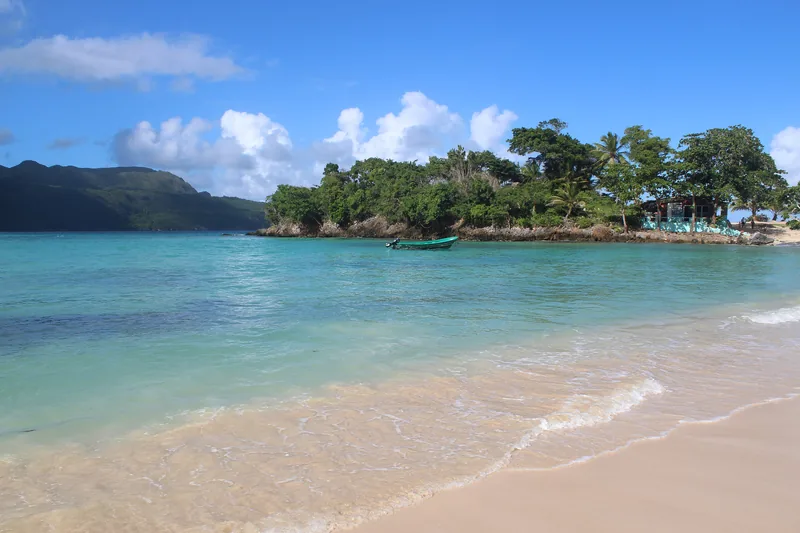
If Rincón is the best beach you can reasonably visit, Bahía de las Águilas is the best beach you have to really want. It is an eight-kilometer arc of undeveloped white sand at the far southwestern tip of the country, inside Jaragua National Park, close to the Haitian border. There is no road along it, no hotel on it, and no development of any kind behind it, because it is protected parkland. What there is: bone-white sand, absurdly clear water, dry cactus hills falling into the sea, and, most days, almost nobody.
This is the beach people mean when they say the Dominican Republic still has wild places. Because it sits inside a national park with no coastal road, the standard way in is to drive to the fishing hamlet of Las Cuevas, near Cabo Rojo, and take a small boat around the point, or to reach it by four-wheel-drive over rough tracks. Either way there are no services once you arrive, so you carry your own water, food, and shade. That is the price of admission, and it is exactly why the beach looks the way it does.
The catch, stated plainly
It is far. Pedernales province is roughly six to seven hours by road from Santo Domingo, across the length of the south. Nobody sane does Bahía de las Águilas as a day trip from the capital. You do it as the centerpiece of a southwest loop, usually basing a night or two in Pedernales or back toward Barahona, which is itself one of the most underrated and least-touristed corners of the country. If you have a week and a taste for empty landscapes over swim-up bars, this trip is the most memorable beach experience the DR offers. If you have four nights and want to be horizontal by lunchtime, it is the wrong beach and you should know that now. The full logistics live in the Bahía de las Águilas guide.
3. The wild coves of Samaná: Frontón and Madama
Rincón gets the fame, but the Samaná Peninsula hides a second tier of beaches that would headline anywhere else. Two stand out, and both share Rincón's defining trait: you cannot simply drive up and park.
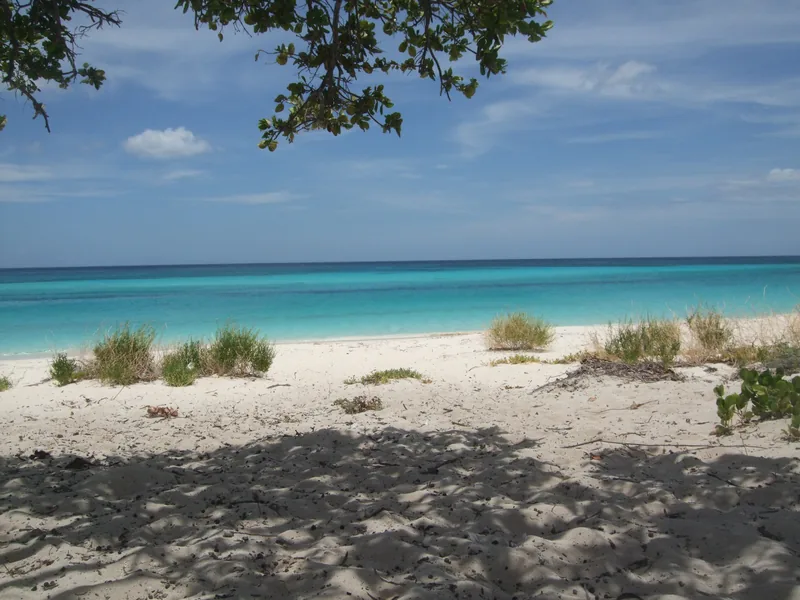
Playa Frontón is a small, dramatic cove backed by a sheer cliff face, reachable by boat from Las Galeras or by a hot, sweaty hike through the bush. The reward is some of the best snorkeling on this coast, with rock and reef close to shore and clear water over it. Playa Madama is a tighter, shadier horseshoe on the same stretch, smaller and calmer, good for a quiet swim and a picnic. Neither has real facilities, both are best arranged as a boat loop out of Las Galeras that strings together Rincón, Frontón, Madama, and the little La Playita near town, and both reward the traveler willing to spend a morning on the water rather than in a lounger.
What ties this whole eastern tip together is that Las Galeras functions as the launch point. Spend your Samaná nights there, hire a boat for a day, and you can knock out three or four of the finest beaches in the country in a single unforgettable outing. The Samaná Peninsula guide maps the boat loops and the timing.
4. Playa Cosón and the Las Terrenas beaches
On the north shore of the same peninsula sits Las Terrenas, a former fishing village turned relaxed, French-and-Italian-flavored beach town, and the beaches around it make up the fourth entry. This is Samaná in its softer, more accessible register: still lovely, far less of an expedition.
Playa Cosón is the standout, a long, wide, golden-sand beach west of town with room to breathe, a scatter of beach restaurants at one end, and long empty stretches everywhere else. Closer in, Playa Bonita and Playa Las Ballenas put you steps from town cafes and a genuinely good food scene. The trade against Rincón is honest: these beaches are prettier to eat and drink near, easier to reach, and a notch less wild. You can walk to sand from a Las Terrenas guesthouse, which you cannot really do at Rincón.
Las Terrenas is also the most comfortable Samaná base for travelers who want a beach town with restaurants and nightlife rather than a sleepy village, and it is around two and a half hours from Santo Domingo on the modern Samaná highway, closer than Las Galeras. If your ideal is good food, an easy swim, and a sunset, this stretch delivers it without the boat ride.
5. The north coast: Playa Grande, Cabarete, Sosúa
The old tourism coast around Puerto Plata is where Dominican beach tourism started in the 1970s, and it has aged unevenly. Some of it is tired. Some of it is excellent. Here is the honest sort.
Playa Grande
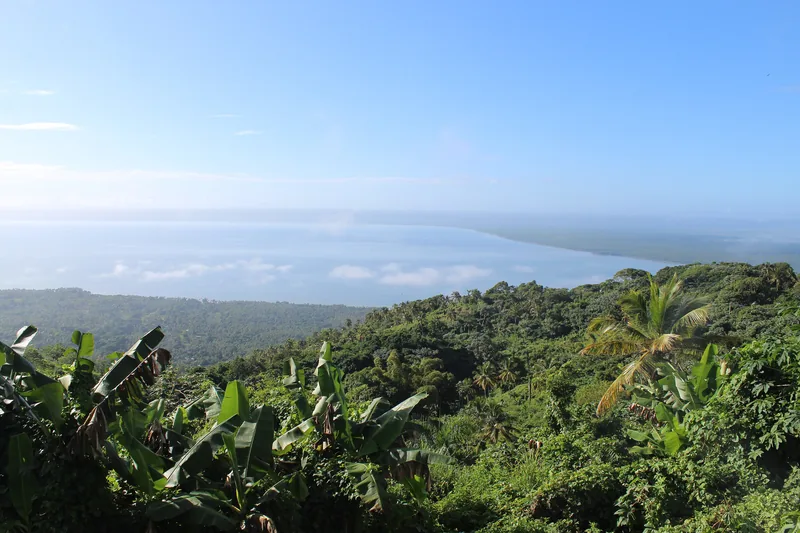
Near Río San Juan, east of the main resort strip, Playa Grande is the north coast's best beach: a broad, dramatic, golden sweep backed by cliffs and sea grape, with real Atlantic energy in the surf. It is wide, handsome, and far less built up than the Puerto Plata resorts to its west. The waves can be strong, so it is a beach for confident swimmers and beach walkers more than for toddlers, but for sheer scenery it earns its place.
Cabarete
Cabarete is the country's watersports capital, and its personality is the wind. The same steady breeze that makes the swimming ordinary makes it a world-class kitesurfing and windsurfing beach, with a young international crowd, beachfront bars, and a genuinely fun after-dark scene. Come here to learn a sport or to watch the kites, not for a glassy swim. Nearby Playa Encuentro is the surf beach.
Sosúa
Sosúa's saving grace is its bay: a calm, protected, horseshoe cove with clear water and easy snorkeling, backed by a wall of vendor stalls and bars. The beach itself is genuinely nice for a swim and for families; the town around it is a mixed bag with a frank nightlife reputation worth knowing about before you book. Sosúa also carries a remarkable, little-known history as the town that took in Jewish refugees in the late 1930s, a story worth reading about before you visit.
The north coast as a whole sits three and a half to four hours from Santo Domingo and is best reached by comfortable long-distance coach into Puerto Plata, then local transport along the coast. It is greener, breezier, and cheaper than Punta Cana, with more texture and more rough edges.
6. Punta Cana and Bávaro: the honest verdict
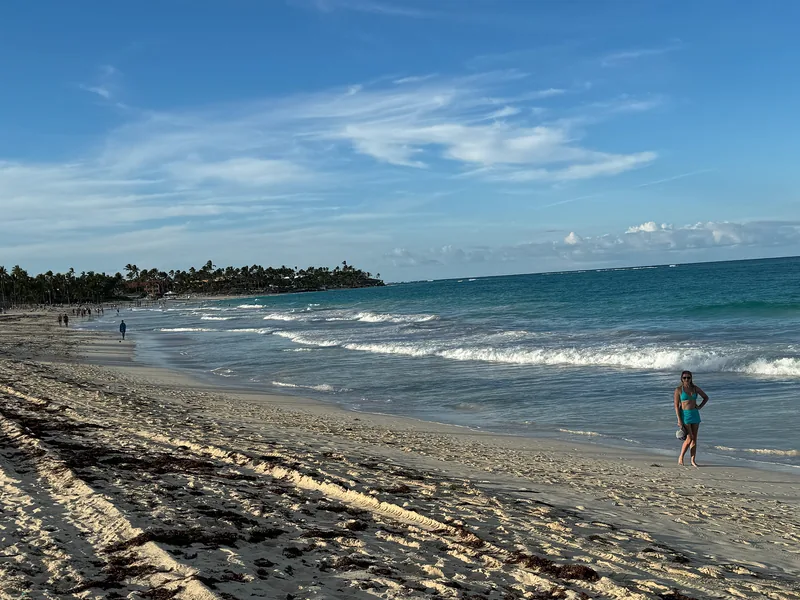
Now the beach most people picture when they think Dominican Republic, and the one I am going to be straight about. Punta Cana and the long Bávaro strand beside it are exactly what the pictures show: kilometers of soft, pale sand, coconut palms, warm water, and a reef offshore that keeps the sea calm and swimmable almost every day. The sand is genuinely good. The water is genuinely warm and clear. If your definition of a beach vacation is a lounger, a piña colada, and a flat sea you can wade into with a toddler, this coast is built for you and delivers it reliably.
Here is the tradeoff, stated as promised. That entire strand is lined, end to end, with all-inclusive resorts, and the experience is shaped around them. The beach is calm and pretty but tame. It does not have the drama of Playa Grande, the emptiness of Bahía de las Águilas, or the wild green backdrop of Rincón. Much of it is functionally private, sorted by which resort owns the loungers in front of you, and the parts that feel most like the real country, like the more natural, surf-touched Playa Macao, sit at the edges. You are buying convenience, predictability, and zero logistics, and paying for it in character.
That is not a knock, it is a description. Plenty of travelers want precisely that and are right to book it. Just go in clear-eyed: Punta Cana is the most comfortable beach in the country and nowhere near the most beautiful. If you want the full argument, with the good and the bad laid out, read the honest Punta Cana beaches guide and the head-to-head on Las Galeras versus Punta Cana. Punta Cana is around two to two and a half hours east of Santo Domingo on the modern Coral Highway, which is what makes the compromise of basing in the capital and visiting for a day or two so workable.
7. Isla Saona and the eastern islands
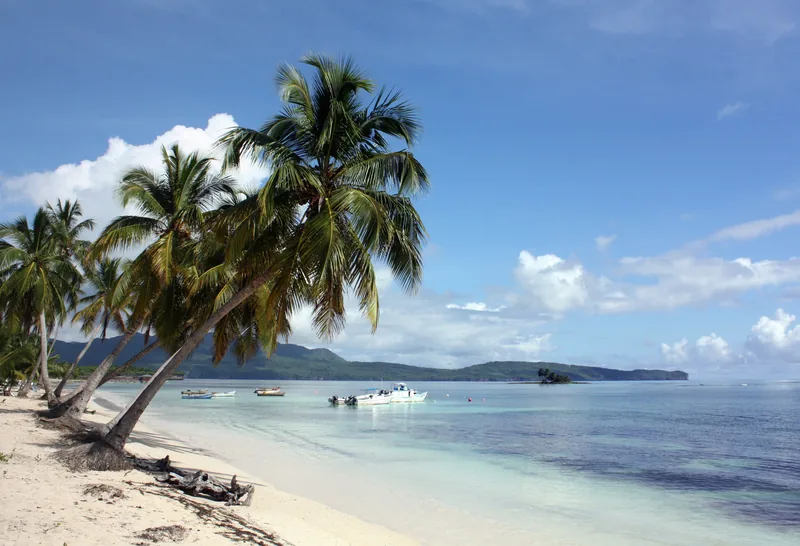
Saona deserves its own entry because the sand is real and the experience is complicated. The island sits inside Parque Nacional del Este off the southeast coast, reached by catamaran and speedboat from Bayahibe near La Romana, and its beaches are postcard material: white sand, coconut palms leaning over turquoise shallows, and the famous natural swimming pool offshore where you can stand waist-deep a long way from land.
The beach is a nine. The day trip is a five, and you should separate the two in your head. The standard Saona excursion is a high-volume operation: big boats, loud music, a buffet lunch on the sand, and a lot of other people who all arrive and leave at the same time. It can be a genuinely fun day if you go in expecting a party boat to a beautiful island rather than a serene castaway experience. To improve your odds, look for smaller-group or early-departure tours, and treat the natural pool and the quieter far end as the highlights rather than the lunch stop. Bayahibe is about an hour and a half to two hours east of Santo Domingo, which keeps Saona firmly in day-trip range from the capital.
8. Boca Chica and Juan Dolio: the capital's beaches
Last on the ranking, first in convenience. These are the closest swimmable beaches to Santo Domingo, and I rank them honestly rather than generously. Neither will make anyone's Caribbean top ten, and both are exactly the right answer for a half-day when you do not want to commit to an overnight.
Boca Chica, about thirty-five minutes east of the capital, is a shallow, reef-protected lagoon of flat turquoise water, so calm and so shallow you can wade out a long way. It is a local, lively, unpretentious beach: music, plastic chairs, whole fried fish, families on weekends. Go on a weekday morning for the calm version and it is a genuinely pleasant few hours. Go on a Sunday afternoon and it is a loud, crowded, very Dominican party, which some travelers love and some do not.
Juan Dolio, a little farther east at around fifty minutes, is the longer, quieter, more spread-out alternative, with a calmer strip of sand and mellower beachfront restaurants. It is the better pick if you want to swim and read rather than swim and dance.
Neither is a destination in its own right. Both are the smart move when you are based in Santo Domingo, have a free afternoon, and want your feet in warm water without a four-hour drive. The practical details, including how to do each without a rental car, are in the Boca Chica and Juan Dolio guide.
The beaches, ranked by how hard they are to reach
Here is the same list re-sorted on the other axis, so you can see the tradeoff at a glance. From easiest to hardest:
- Boca Chica and Juan Dolio: 35 to 50 minutes from Santo Domingo by taxi or ride app. A half-day, no planning.
- Isla Saona: a long but easy day trip on an organized tour out of Bayahibe, about two hours from the capital.
- Punta Cana and Bávaro: two to two and a half hours east on a good highway, easiest as a two-or-three-night resort stay or an overnight.
- The north coast (Puerto Plata, Sosúa, Cabarete): three and a half to four hours by coach, then local hops, an overnight minimum.
- Las Terrenas and Playa Cosón: around two and a half hours to the Samaná north shore, a comfortable overnight.
- Playa Rincón, Frontón, and Madama: three and a half to four hours to Las Galeras, then a boat, a two-to-three-night trip done properly.
- Bahía de las Águilas: six to seven hours to the far southwest, then a boat or four-wheel-drive, a multi-day expedition and worth every hour.
Notice the pattern. The ranking of quality is almost the exact reverse of the ranking of ease. That is the whole story of Dominican beaches in one list, and it is why the trip you plan should start with an honest answer to one question: how far are you actually willing to go for sand.
How to reach the good ones without a rental car
You do not need to rent a car to see most of these, and given the driving conditions in parts of the country, many travelers are better off not. Here is what actually works.
- Ride apps in and around cities. Uber works well in Santo Domingo, in Santiago, and across the Punta Cana and Bávaro area. It is the easy way to Boca Chica and Juan Dolio and to get around within a beach zone once you arrive.
- Long-distance coaches. Comfortable, air-conditioned bus lines connect the capital to Samaná, Puerto Plata, and the Punta Cana region for a modest fare, usually in the low tens of dollars one way. This is the backbone of car-free travel here and it is genuinely pleasant.
- Guaguas for short hops. The local minibuses are cheap, frequent, informal, and how Dominicans actually move between nearby towns. Fine for short legs like Las Galeras to Samaná town once you are on the peninsula.
- Boats for the wild beaches. Rincón, Frontón, Madama, and Bahía de las Águilas are all reached by small boat arranged locally. Agree the price and the return time before you step aboard, and go in the morning when the sea is calmest.
- Organized day tours for the ones that are genuinely hard to self-drive, especially Saona and the Bahía de las Águilas region, where a tour handles the boat, the park, and the logistics.
The one place a rental car earns its keep is a self-paced southwest or Samaná loop where you want to stop at river mouths and viewpoints on your own schedule. For everything else, coaches and ride apps cover it. The full breakdown is in the guide to getting around the Dominican Republic.
What a beach trip actually costs
Rough ranges, because real prices move and you should check current ones before you commit. Treat these as orientation, not quotes.
- A half-day at Boca Chica or Juan Dolio: the cost of a round-trip ride app plus lunch and a few drinks on the sand. An easy, cheap afternoon.
- A coach to Samaná or Puerto Plata: a modest one-way fare, typically in the low tens of dollars per person, plus local transport at the far end.
- A Saona day trip: a per-person tour price that usually lands somewhere in the mid-to-higher tens of dollars, often including transport, boat, lunch, and drinks. Smaller-group versions cost more.
- A boat to Playa Rincón from Las Galeras: negotiated locally, cheaper shared, more for a private run, and very reachable if you split it with others on the beach that morning.
- Bahía de las Águilas: the beach itself is nearly free once you are there; the cost is the multi-day trip to reach the far southwest, plus the boat from Las Cuevas.
The pattern holds on money too. The convenient beaches are cheap to reach and the spectacular ones cost you mainly in time and distance rather than cash. Budget for food and drinks on the sand at the wilder beaches, since the beach kitchens at Rincón take cash and there is nothing at all behind Bahía de las Águilas. A little planning, a full water bottle, and small bills go a long way at the beaches that have no cash machine and no shop for miles.
When to go
The Dominican Republic is a year-round beach country, warm in every month, but a few seasonal notes shape a beach trip.
- December to April is the dry, high season: the most reliable sun, the calmest seas for boat days to Rincón and Bahía de las Águilas, and the busiest, priciest resorts. It is the safest window for the trips that depend on a boat.
- Whale season runs roughly mid-January to mid-March in Samaná Bay, when thousands of humpbacks arrive to breed. If you are going to Samaná for the beaches anyway, timing it to overlap is one of the best add-ons in the country.
- Hurricane season runs June through November, peaking late summer into autumn. Most days are still fine and prices drop, but keep an eye on forecasts and build in flexibility, especially for boat-dependent beaches.
Seas are generally calmer on the south and east coasts and livelier on the Atlantic-facing north coast, which is worth knowing if easy swimming matters more to you than surf.
Which beach for which traveler
If you would rather match the beach to the person than read the whole countdown, here is the short version.
- The photographer who will drive for the shot: Bahía de las Águilas first, Playa Rincón second. Nothing else in the country comes close for untouched scale.
- The couple who want one beautiful trip, not an expedition: Las Galeras as a base, with a boat day to Rincón, Frontón, and Madama. The best ratio of beauty to effort in the DR.
- Families with small kids: the calm, shallow water of Boca Chica for a day out, or a reef-protected resort strip in Bávaro for a week where the sea barely moves.
- The all-inclusive, zero-logistics vacation: Punta Cana or Bávaro, booked without guilt. It is the most comfortable beach coast in the country and it knows it.
- The active traveler: Cabarete for wind and kites, Playa Encuentro or Playa Grande for surf, Sosúa bay for easy snorkeling.
- The traveler who wants the real country with beaches on the side: base in the capital and treat the coast as a set of trips. That is the case I make below.
- The one-day beach fix from Santo Domingo: Boca Chica or Juan Dolio in the morning, home by evening.
A word on seaweed and swimming safety
Two honest notes the brochures skip. First, sargassum. In some years, patches of the country's east and southeast coasts, including parts of the Punta Cana and Bávaro strand, get hit by drifting mats of brown seaweed, mostly in the warmer months from roughly spring into late summer. It comes and goes, resorts rake their sections, and the Samaná and southwest beaches on this list are generally far less affected because of how the currents run. If a glassy, seaweed-free swim is your whole reason for coming, ask about current conditions for your specific dates and coast before you book.
Second, the water itself. The south and east coasts are usually calm and easy. The Atlantic-facing north coast, and open beaches like Playa Grande, can produce real surf and rip currents, and lifeguards are not a given at Dominican beaches the way they are in some countries. Swim within your depth, respect a rough sea, keep an eye on children in the water, and do not assume someone is watching. None of this should scare you off. It should just keep the good day a good day.
Where to base yourself, and why the capital works
Here is the argument I promised at the top. The instinct is to pick one beach, book a resort in front of it, and stay put. For a certain trip that is right. But the Dominican Republic's best beaches are scattered across four coasts, and a single resort locks you onto one of them for the whole week, usually the tamest one. Base yourself in the colonial heart of Santo Domingo instead and the whole coast opens up as a series of trips: Boca Chica and Juan Dolio for an easy afternoon, Saona and Punta Cana within a day's reach to the east, Samaná an easy overnight to the northeast, and the wild southwest as an expedition when you want it. In between, you come home each evening to a real, living, five-hundred-year-old city rather than a lobby.
Pick one beach and you see one beach. Base in the capital and the whole coast becomes a menu.
That is the thinking behind the penthouse, a three-suite top-floor stay in the Zona Colonial with a roof terrace over the old town and the sea. You wake up in the first city of the Americas, walk to coffee on a coral-stone street, ride out to warm water for the day, and come back to a terrace at sunset instead of a buffet line. It sleeps six, ride apps reach the door, and it is booked through Airbnb where it carries strong reviews and a perfect location score. If the version of the Dominican Republic you want is the real country with its best beaches as day trips and short hops rather than a gated strip you never leave, that is the trip it is built for.
Start with Rincón, earn Bahía de las Águilas, and let Punta Cana be the easy day rather than the whole vacation. That is how you actually see the best beaches in the Dominican Republic.