Santo Domingo Landmarks: Cathedral, Alcázar and More
August 2026 · 22 min read
The great Santo Domingo landmarks sit within a ten-block walk of one another, and that is the single most useful thing to know before you visit. The first cathedral built in the Americas, the oldest surviving European fort in the hemisphere, the palace the Columbus family lived in, a national mausoleum, and two sets of roofless ruins are all packed into the same small grid of coral-stone streets in the Ciudad Colonial. You do not need a car, a tour bus, or a full day of logistics. You need decent shoes, an early start, and a sensible order to walk them in.
This guide gives you that order, and more than that, it tells you what each place actually is, what you will see when you step inside, how long it honestly takes, and which ones reward a ticket versus which ones you can appreciate from the street. I will be specific about the history because the history is the entire reason these buildings matter, but I will not drown you in dates. By the end you will be able to string the whole set together in a single good morning, or spread them across two relaxed days, and know exactly what you are looking at while you do it.
How the Santo Domingo landmarks fit together
Before the individual buildings, get the map in your head, because it makes everything else easy. The monuments cluster along two parallel lines. The first is the river edge, where Calle Las Damas, the oldest paved street in the Americas, runs north to south one block in from the Ozama. Along that single street you get the Fortaleza Ozama at the south end, the Panteón Nacional and the Casas Reales in the middle, and the Alcázar de Colón at the north end above the Plaza de España. The second line is the cathedral and its square, Parque Colón, one block west of Las Damas at the southern end. The two ruins, the Hospital San Nicolás de Bari and the Monasterio de San Francisco, sit slightly uphill and inland from all of this, a few blocks northwest.
Put simply, you can walk from the fort to the cathedral to the palace to the ruins in a rough loop, and the whole circuit covers maybe a kilometer and a half of actual ground. The reason it takes a morning rather than twenty minutes is that you keep stopping to go inside things. If you want the neighborhood context around these monuments, the streets and plazas and where to eat between them, the complete Zona Colonial guide covers the setting in full. This page is about the landmarks themselves.
One orientation trick that never fails you here: the Caribbean is always to the south and downhill, the Ozama River is always to the east. If you can see water, you can find your way. Now, the buildings, roughly in the order a good walk takes them.
Catedral Primada de América: the first cathedral in the Americas
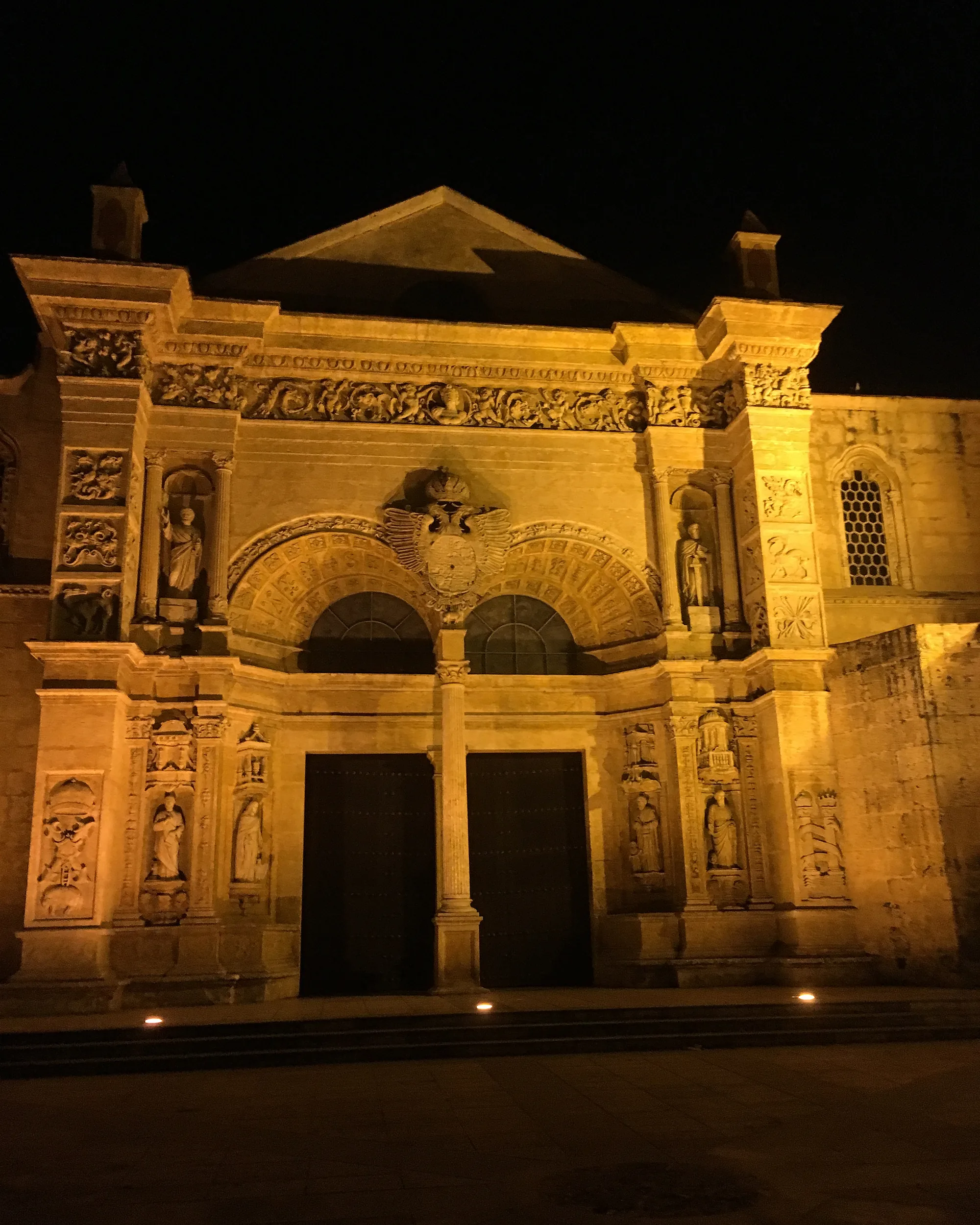
Start with the headliner. The Catedral Primada de América, the Cathedral of Santa María la Menor, is the oldest cathedral in the Americas, built between 1512 and 1540 on the south side of what is now Parque Colón. That span of dates matters: it went up over nearly three decades, which is why the building is a conversation between styles rather than a single statement. The great west facade, the coral-limestone frontage you photograph, is late Gothic sliding into Renaissance, all the way down to the classical columns framing the main door. Inside, the vaulting is Gothic. The overall effect is of a building caught mid-thought between the medieval world and the one that replaced it, which is exactly what it was.
What you actually see inside
You enter into a wide, cool, dim nave, and the first thing you feel is the temperature drop, which in the Santo Domingo heat is its own small reward. The stone holds the cool of the night well past noon. The nave runs to a set of fourteen side chapels, and it is the chapels, not the main altar, that reward slow looking. Each was endowed by a different family or guild over the centuries, so they vary wildly: some are heavy with dark colonial wood and gilt, some hold old tombs and worn stone effigies, some are plain to the point of austerity. There is a good deal of silver, some genuinely fine baroque woodwork, and the sort of accumulated five-century clutter of relics and side altars that a living cathedral gathers.
For years the cathedral claimed to hold the remains of Christopher Columbus, and an elaborate monument marked the spot before the bones were moved to the Faro a Colón lighthouse across the river in 1992. Spain, for what it is worth, insists the real remains are in Seville. Nobody has fully settled it, and the cathedral is comfortable with the ambiguity. Ask a guide and you will get a good story either way.
How long it takes and how to do it right
Give the cathedral thirty to forty-five minutes if you go inside, which you should. There is a modest entry fee, usually including an audio guide, and hours are broadly daytime with a midday break and reduced access during Mass and on Sundays. Check current times before you plan around it, because they shift with the church calendar. Two practical notes. First, this is an active place of worship, so modest dress is expected: shoulders and knees covered, and they will hand you a wrap at the door if you turn up in a tank top and shorts. Second, come early. The cathedral is the single most visited thing in the district, and by mid-morning the cruise groups fill the nave. At opening it is close to empty and the light through the west door is worth being there for.
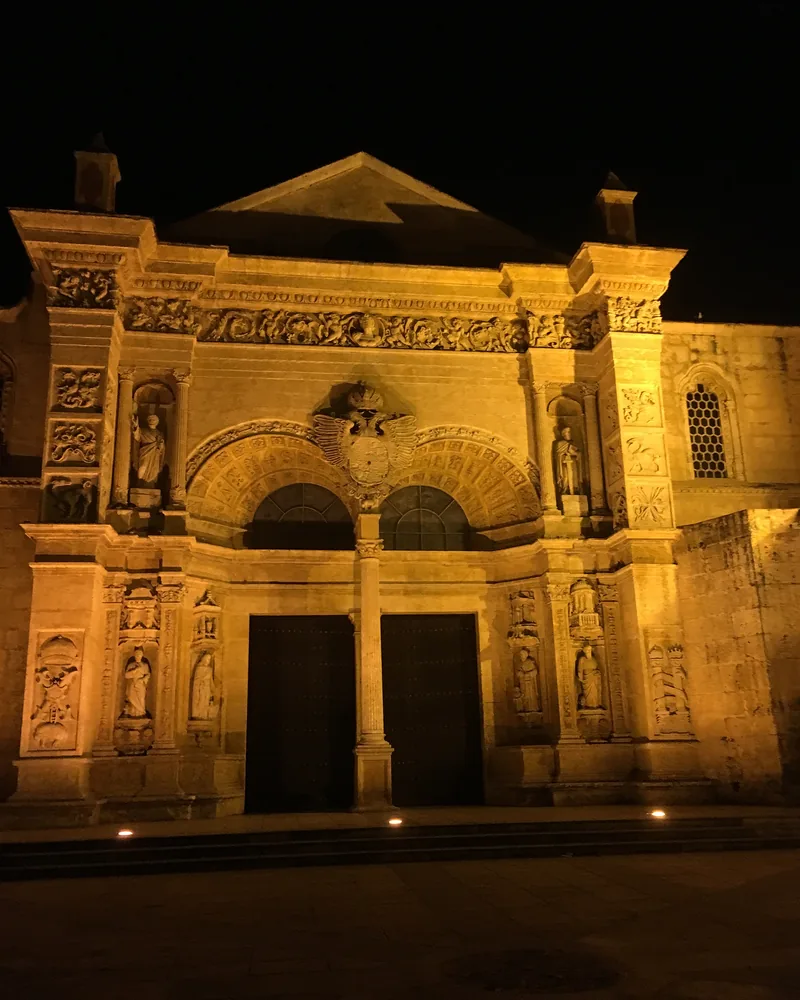
Even if you skip the interior, stand in Parque Colón and look up at the facade for a few minutes. This is the most photographed wall in the country for a reason, and the square in front of it, with its Columbus statue and its pigeons and its ring of cafes, is the natural pivot point for the rest of the walk. Have your first coffee here.
Fortaleza Ozama: the oldest fort in the Americas
Walk from the cathedral down toward the river and the south end of Calle Las Damas and you reach the Fortaleza Ozama, begun in 1502. It is the oldest surviving European military fortification in the Americas, which is not a marketing line but a plain fact of dates: nothing built by Europeans for war on this side of the ocean is older and still standing. It guarded the mouth of the Ozama River, and therefore the port, and therefore the whole young colony, for the better part of four centuries. It was a working military installation into the 1970s, which is a strange thing to absorb when you are looking at walls laid in the reign of Ferdinand and Isabella.
The Tower of Homage and the grounds
The centerpiece is the Torre del Homenaje, the Tower of Homage, a squat, thick-walled keep that dominates the compound. You can climb it, and you should, because from the top you get the river, the harbor, and the sightline the fort's defenders actually used to watch for ships coming in from the Caribbean. The stairs are narrow and worn and there is no elevator, so factor that in. Down at ground level the grounds are pleasant and green, dotted with old cannon, a statue of the chronicler Gonzalo Fernández de Oviedo who once commanded the place, and long stretches of rampart you can walk along above the river.
Be honest with yourself about what this is: it is more grounds and views than museum. There are few furnished interiors and not a lot of interpretive signage. What you are buying with the small entry fee is the walls, the tower climb, and the setting above the water, and on those terms it is well worth an hour. The light down here in the early morning, before the heat, is the best in the district, and the fort is the reason to walk this far south.
How long and a practical note
Budget forty-five minutes to an hour, more if you linger on the ramparts. There is a small admission charge and daytime hours. Freelance guides gather at the gate and will offer to walk you through for a tip; some are genuinely knowledgeable and some are winging it, so agree on a price up front if you want one, and feel free to decline and wander on your own. The site is compact enough that you will not miss anything unguided.
Calle Las Damas: the street that connects the monuments
From the fort, the rest of the heavyweight landmarks line up along a single street, so it is worth pausing on the street itself. Calle Las Damas was laid down in 1502, the first paved street in the Americas, named for the ladies of the viceregal court who took their evening walks along it. It is a straight, narrow run of coral stone and colonial facades, shaded for much of the day, and walking its length is one of the genuine pleasures of the district independent of going into any single building.
You do not buy a ticket for the street, you just walk it, ideally in the morning or the late afternoon when the light is on the stone. As you go north you pass, in order, the Fortaleza at the south end, the old Jesuit church that is now the Panteón, the mansion that is now the Hostal Nicolás de Ovando, the Casas Reales at the top, and then the street opens onto the Plaza de España with the Alcázar beyond. Almost everything below is on this one line. Take it slowly. The point of staying inside the walls, at somewhere like the penthouse a few minutes from here, is that you can walk this street at seven in the morning with a coffee and have it nearly to yourself.
Panteón Nacional: the national mausoleum
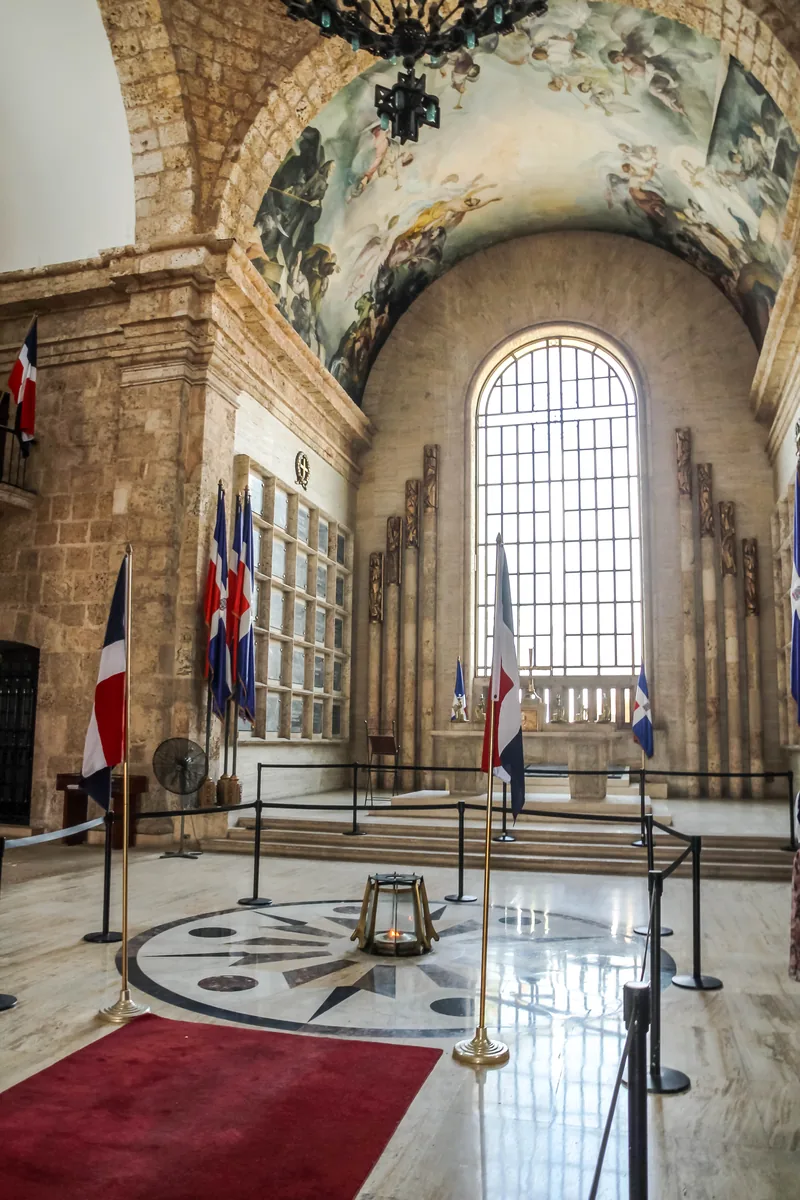
About halfway up Las Damas stands a heavy, dignified stone building that began life in the 1740s and 1750s as a Jesuit church, and now serves as the Panteón Nacional, the national mausoleum where the Dominican Republic honors its dead. The exterior is austere neoclassical, cut from the same coral limestone as everything else. Inside is where it lands: a solemn, high-ceilinged single space, dim and cool, with an eternal flame, an enormous chandelier reportedly gifted by the Spanish dictator Franco, and the tombs and memorials of national heroes ranged around the walls. Founding fathers, presidents, poets, and generals rest here under a soldier's honor guard that stands watch and changes on a schedule.
What you see is not busy or ornate, and that is the point. It is meant to be sober, and it is. Give it fifteen minutes. Entry is free, but there are two firm rules the guards will enforce: dress respectfully, meaning covered shoulders and no beachwear, and no photographs inside, or at least none of the flagrant, phone-held-high kind. Take your hat off. This is a place Dominicans take seriously, a working monument rather than a tourist attraction, and the right way to visit is quietly and briefly. It sits so directly on the walking route that there is no reason to skip it.
Alcázar de Colón: the Columbus family palace
At the north end of Las Damas the street opens onto the Plaza de España, the grandest open space in the district, and across it stands the Alcázar de Colón. This is the palace Diego Colón, son of Christopher Columbus and viceroy of the Indies, built for himself and his wife María de Toledo in the second decade of the 1500s. For a couple of generations it was the seat of Spanish colonial power in the New World, the house from which the Americas were, in a real sense, administered. It fell to ruin over the centuries and was restored in the middle of the twentieth, and today it is the best single interior you can visit in the whole district.
What you see inside
Unlike the fort, the Alcázar is furnished, and furnished well. The restoration filled its two floors of arcaded galleries and stone-walled rooms with genuine period pieces, late-medieval and Renaissance furniture, tapestries, religious paintings, dark carved wood, coffered ceilings, and household objects, arranged to show how a viceregal family actually lived at the dawn of the colonial era. You move through bedchambers, a chapel, reception rooms, and kitchens, with an audio guide that is better than most, and you come away with a concrete sense of the period that no amount of reading gives you. The galleries look out over the plaza on one side and toward the river on the other, and the building itself, all rounded arches and heavy stone, is as much the exhibit as the objects inside it.
How long and when to go
This is the one interior to prioritize if you only have time or appetite for one. Give it an hour, more if you use the full audio guide. There is an entry fee, larger than the cathedral's but still modest by international-museum standards, and daytime hours with a probable closed day midweek, so check before you count on it. The Plaza de España outside is the district's best evening spot, ringed with restaurants whose tables spill out under the arcades at sunset, so a smart plan is the Alcázar in the cooler part of the day and a drink on the plaza later. The Zona Colonial guide has more on eating and drinking around this square.
Museo de las Casas Reales: the royal houses
Back a short way down Las Damas, between the Panteón and the plaza, are the Casas Reales, the Royal Houses, a pair of joined sixteenth-century palaces that once held the machinery of Spanish government in the Americas. This was the seat of the Real Audiencia, the first high court in the New World, along with the governor's offices and the colonial treasury. Today it is the Museo de las Casas Reales, and it is the best straight history museum in the district, the place to go if you want the story rather than just the stones.
What you see inside
The collection is broad and genuinely good. You move through rooms covering the conquest and the colonial administration, indigenous Taíno artifacts, colonial-era arms and armor, navigation instruments, and a striking display built around treasure and cargo recovered from Spanish shipwrecks in Dominican waters. There is a fine collection of period weapons and a lot of well-presented material on how the colony was actually run: the laws, the courts, the trade, the machinery of empire. Signage is a mix of Spanish and English. Out front stands the Reloj de Sol, a stone sundial built in 1753 so the officials working inside could tell the time by glancing out the window, which is a lovely small detail to look for.
How long and why it matters
Give it forty-five minutes to an hour. There is a modest entry fee and daytime hours. If the Alcázar shows you how people lived, the Casas Reales shows you how the colony worked, and the two together make far more sense than either alone. For the deeper background on any of it, the site's history of Santo Domingo traces the through-line from 1498 to now, and it is a good thing to read on the plane. This museum is the physical version of that story.
The ruins: San Nicolás and San Francisco
Not every important building here survived intact, and two of the most affecting Santo Domingo landmarks are ruins, roofless coral-stone skeletons a few blocks uphill and inland from the river monuments. Do not skip them because they are broken. In some ways the ruins move you more than the restored palaces, because the sky is where the roof used to be and you can feel the centuries in the missing parts.
Hospital San Nicolás de Bari
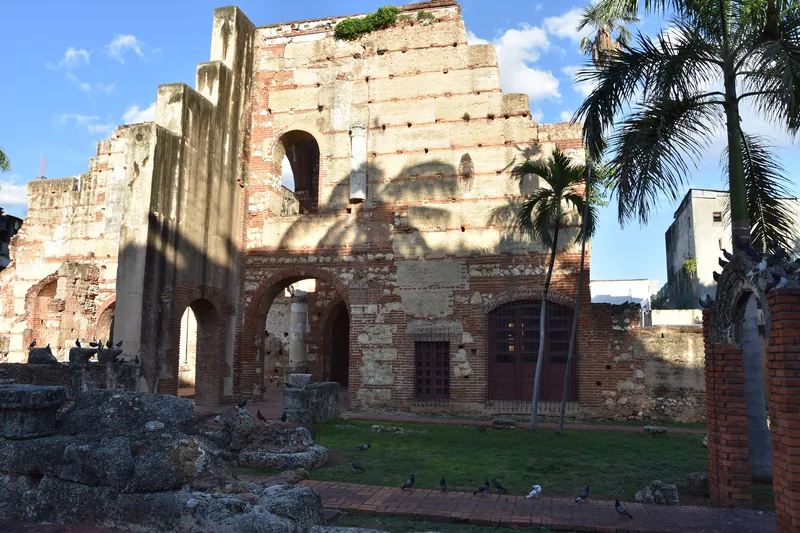
On Calle Hostos stand the remains of the Hospital San Nicolás de Bari, begun around 1503 and the first hospital built in the Americas. It functioned as a hospital for centuries before earthquakes and time brought the roof and much of the structure down. What survives is a tall, graceful shell of arches and walls, the nave and aisles of what was as much church as hospital, open to the sky and framed by the ordinary residential street around it. You generally view it from the street through the railings rather than walking among the stones, and that is enough. It takes five minutes and it is free, and the sight of these five-hundred-year-old arches standing in the middle of a lived-in neighborhood, laundry on the balconies opposite, is one of the quiet highlights of the district.
Monasterio de San Francisco and the Sunday Bonyé nights
A little further along, up Calle Hostos toward Calle Emiliano Tejera, are the larger and more dramatic ruins of the Monasterio de San Francisco, the first monastery in the Americas, begun in 1508. This complex was battered over the centuries by earthquakes, by a hurricane, and by Francis Drake's raid on the city in 1586, and it was never rebuilt. What remains is a substantial run of massive walls, arches, and empty window openings climbing the hillside, floodlit at night and genuinely imposing.
Here is the reason to time a visit for a Sunday evening. The ruins host an open-air street party, the Bonyé nights, where a veteran group sets up amid the old walls and plays live merengue and son to a crowd of locals and visitors who dance in the street until late. It is free, it is unpretentious, it is one of the most purely enjoyable nights out in the city, and it happens against the backdrop of a five-century-old ruin. If your stay includes a Sunday, put this on the plan. To understand what you are hearing and why this music runs so deep here, the merengue and bachata primer is the companion read. By day the ruins take ten minutes and are viewed from outside; by Sunday night they turn into the best free show in town.
The other landmarks worth knowing
Those seven are the core, but a few more sights round out the set and fall naturally into the same walk.
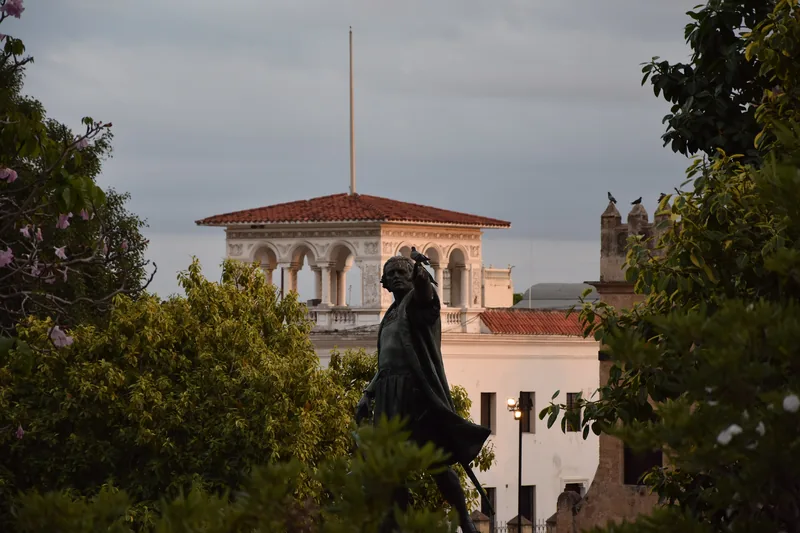
- Parque Colón and the Columbus statue. The main square in front of the cathedral, with its bronze Columbus, its cafes, and its constant low hum of city life. Not a monument to tour so much as the room the monuments open off. You will pass through it repeatedly.
- Puerta del Conde and Parque Independencia. At the far western end of the pedestrian street El Conde stands the old city gate where, in 1844, the republic was declared and the national flag first raised. Behind it, the Altar de la Patria holds the remains of the three founding fathers, Duarte, Sánchez, and Mella, under a permanent honor guard. It is a fifteen-minute walk west of the cathedral and a natural end point.
- Plaza de España and the Atarazanas. The grand plaza below the Alcázar and the old royal shipyards and customs houses along its lower edge, now restaurants and a museum. This is where the walk naturally deposits you for lunch or an evening drink.
- Calle El Conde. Not a monument but the pedestrian spine that links the cathedral end of the district to the Puerta del Conde, and the easiest way to cross from the historic core to the western gate on foot.
None of these needs a ticket, and all of them sit on or just off the loop you are already walking. Think of them as the connective tissue between the ticketed sites.
A walking order that strings it all together
Here is the route I would actually walk, sequenced so the light and the heat work for you rather than against you. It assumes an early start, which is the whole trick. Done at a steady pace with interior visits, this is a three-to-four-hour morning.
- Coffee in Parque Colón, around opening time. Sit under the cathedral facade with a cafecito and let the district wake up. This is your staging point.
- Catedral Primada de América. Go in first thing, before the groups, thirty to forty-five minutes inside the first cathedral in the Americas.
- South down to the Fortaleza Ozama. Walk the river end of Las Damas to the fort, climb the Tower of Homage for the harbor view while the morning air is still cool, forty-five minutes to an hour.
- North up Calle Las Damas. Walk the oldest paved street in the Americas slowly, stopping at the Panteón Nacional for a quiet fifteen minutes.
- Museo de las Casas Reales. The royal houses and the history museum, forty-five minutes to an hour, with a look at the 1753 sundial out front.
- Alcázar de Colón and the Plaza de España. The Columbus palace, the best interior of the day, an hour. Step out onto the grand plaza when you are done.
- Uphill to the ruins. Walk inland to the Hospital San Nicolás de Bari and then the Monasterio de San Francisco, five to ten minutes at each, viewed from the street.
- Optional western tail: Calle El Conde to the Puerta del Conde. If you still have legs, walk the pedestrian street west to the city gate and the Altar de la Patria, fifteen minutes each way.
By the time you finish the core loop, steps one through seven, it will be late morning and hot, which is your cue to stop for a long lunch on the Plaza de España or back near Parque Colón and let the sun pass its peak. If you would rather have this folded into a full day-by-day plan with meals and evenings built in, the three-day Santo Domingo itinerary does exactly that, and the 25 things to do in Santo Domingo list adds the sights beyond the monuments.
How long you actually need, and in what order of priority
If someone put a gun to your head and gave you only two hours, here is the honest ranking. Do the cathedral and the Alcázar, in that order, and walk past everything else. Those two, the first cathedral and the Columbus palace, are the ones you would regret missing, and both have interiors worth the ticket. The fort is the third priority and the best if what you want is a view and a walk rather than rooms. The Casas Reales is the pick if you want the history explained properly. The Panteón and the ruins are quick, free, and on the way, so you fold them in almost for nothing.
A rough time budget for the ticketed interiors, if you go into all of them:
- Catedral Primada de América: 30 to 45 minutes.
- Fortaleza Ozama: 45 to 60 minutes.
- Alcázar de Colón: 60 minutes, more with the full audio guide.
- Museo de las Casas Reales: 45 to 60 minutes.
- Panteón Nacional: 15 minutes, free.
- The two ruins: 5 to 10 minutes each, free, from the street.
Add walking and coffee between them and you land at three to four hours for the whole set, which is why it fits in a morning. Spread over two mornings it becomes downright leisurely, and you can pair each half with a long lunch and an afternoon out of the heat. This is the argument for basing yourself inside the walls rather than day-tripping in from a resort: you can do the landmarks in unhurried pieces across a few relaxed days instead of force-marching them in one sweaty afternoon off a cruise ship.
Tickets, hours, dress and other practical notes
A handful of practical facts will save you friction, and none of them are complicated.
Tickets and hours. Each ticketed site charges its own modest fee, generally in the range of a few hundred pesos, and the Panteón and the ruins are free. I am deliberately not quoting exact prices or hours, because they change, and the worst thing this page could do is send you to a locked door on the strength of an out-of-date number. Check current times before you build your day around any single site. As a rule, the interiors keep daytime hours with a midday break, and one or more of them will be closed on a Monday, so do not save everything for a Monday visit.
Dress. The cathedral and the Panteón are active religious and civic sites and they enforce modest dress: shoulders and knees covered. Keep a light layer in your bag to throw on. Everywhere else, ordinary clothes are fine, but the whole district is walked in the sun, so a hat and real shoes beat flip-flops.
Guides. Freelance guides work the entrances of the cathedral, the fort, and the Alcázar. Some are excellent and add real value, some are not. If you want one, agree the price before you start, tip fairly, and feel no obligation if you would rather wander alone with an audio guide. The official audio guides inside the cathedral and the Alcázar are good and remove the need for a person.
Heat and timing. The stone reflects the sun and there is little shade in the plazas by midday. Start at opening, do the outdoor sites, the fort and the ruins, in the cool of the morning, and save the dim, cool interiors of the cathedral and the museums for when the heat builds. Carry water. The single best decision you will make in this district is getting up early, and it is not close.
Getting here. You will not need a car for any of this, and you should not have one. Everything in this guide is on foot from inside the Zona Colonial. If you are coming from elsewhere in the city, Uber works reliably across the capital and drops you at the edge of the pedestrian core for a few dollars. For the wider case on skipping the rental car, the getting around the DR guide lays it out.
Beyond the monuments: what to do after the walk
Once you have the landmarks under your belt, the district keeps giving, and the best of it is unstructured. Sit in Parque Colón and watch the shoeshine men and the pigeons. Drink a proper cafecito at a counter. Walk the sea wall at dusk near the Montesinos monument, a few minutes south of the monuments and one of the calmest spots in the old town at that hour. Eat comida criolla at a lunch counter rather than a place with a translated menu. The monuments are the skeleton of the district, but the daily life around them is the flesh, and the joy of staying here is that you get both without trying.
If you want more structured ideas for filling the days around the monuments, the things to do in Santo Domingo list runs well past the historic core, out to the cave lakes of Los Tres Ojos, the Malecón, the botanical gardens, and the beaches within an easy hop of the city. The landmarks are the reason people come to the Ciudad Colonial. They are rarely the reason people stay a week. That reason is the living neighborhood the landmarks happen to sit inside.
Using the penthouse as your landmark base
Everything in this guide is easier if you sleep inside the walls. The penthouse occupies the top floor of a 1760s colonial townhouse on the sea edge of the district, a few minutes on foot from the cathedral, the fort, and Las Damas. In practical terms that means you can walk out at opening time with a coffee, do the fort and the cathedral in the good early light before the crowds, come home for the hot part of the day, and wander back out for the ruins or a Sunday Bonyé night without ever getting in a vehicle. The monuments stop being a tour you brace for and become a neighborhood you live in the middle of.
It is a three-suite floor that sleeps six, with a covered gallery and a roof terrace looking out over the Caribbean and the Montesinos monument, which is the view you will want with a coffee at seven in the morning and a rum at seven at night. Guests book directly through Airbnb, where it holds a 4.8-plus rating across 96 reviews and a perfect 5.0 for location, hosted by Waner, who lives in the city. You can see the space in the photo gallery and read what past guests said in the reviews. Book the address, not just the room. The whole point of these Santo Domingo landmarks is that you get to walk out your door and stand inside five centuries of history before breakfast, then come home to a terrace above the first city of the Americas.